
Ideal Gas
SYLLABUS
Ideal gas equation, Molecular properties of matter, Kinetic-molecular model of an ideal gas, Derivation of pressure exerted by gas, Average translational kinetic energy of gas molecule, Boltzmann constant, root mean square speed, Heat capacities: gases and solids.
What is This Chapter About?
Blow air into a balloon and it expands. Heat a sealed gas container and the pressure inside rises. Compress a gas into a smaller volume and its pressure increases. These familiar observations point to a deep question: what is the precise mathematical relationship between the pressure, volume, and temperature of a gas? And what happens at the molecular level to produce these macroscopic behaviours?
Chapter 13 of NEB Grade 11 Physics answers both questions. It begins with the classical gas laws — empirical relationships discovered through careful experimentation — and builds toward the kinetic molecular theory, which explains gas behaviour from first principles by treating gas molecules as tiny, rapidly moving particles. Carrying 8 teaching hours — the second highest in Grade 11 — this is one of the most mathematically rich and conceptually deep chapters in the course, bridging the macroscopic world of pressure and temperature with the microscopic world of molecular motion.
Key Concepts You Will Learn
Pressure and Volume Coefficients — Boyle’s Law and Charles’s Law
Boyle’s Law states that at constant temperature, the pressure of a fixed mass of gas is inversely proportional to its volume:
[latex]PV = \text{constant}[/latex]
. Doubling the pressure halves the volume.
Charles’s Law states that at constant pressure, the volume of a fixed mass of gas is directly proportional to its absolute temperature: [latex]\frac{V}{T} = \text{constant}[/latex]. The pressure coefficient and volume coefficient of a gas both equal [latex]\frac{1}{273}[/latex] per degree Celsius — a remarkable result that connects the gas laws to the absolute temperature scale.
Absolute Zero Temperature
Extrapolating Charles’s Law to lower and lower temperatures predicts that the volume of a gas would reach zero at −273.15°C. This temperature is called absolute zero — the lowest possible temperature, at which molecular motion would theoretically cease entirely. It defines the zero of the Kelvin scale: T(K) = T(°C) + 273.15. On a V-T graph, all ideal gases extrapolate to the same absolute zero, regardless of their composition or initial state.
Ideal Gas Equation
Combining Boyle’s Law and Charles’s Law gives the ideal gas equation:
[latex]PV = nRT[/latex]
where n is the number of moles of gas and R = 8.314 J mol⁻¹ K⁻¹ is the universal gas constant. This single equation encompasses all the classical gas laws and applies to any ideal gas under conditions where intermolecular forces and molecular volume are negligible. For N individual molecules, the equation can be written as [latex]PV = NkT[/latex], where
[latex]k = \frac{R}{N_A} = 1.38 \times 10^{-23}[/latex]
J/K is the Boltzmann constant.
Molecular Properties of Matter
At the molecular level, matter consists of enormous numbers of tiny particles — molecules — that interact through intermolecular forces. In a gas, molecules are far apart and move randomly at high speeds, with negligible intermolecular forces between collisions. The number of molecules in one mole of any substance is Avogadro’s number:
[latex]N_A = 6.022 \times 10^{23}[/latex]
mol⁻¹.
Kinetic Molecular Model of an Ideal Gas
The kinetic theory of gases makes several simplifying assumptions: gas molecules are point particles with negligible volume; they move in random directions with a range of speeds; collisions between molecules and with the container walls are perfectly elastic; there are no intermolecular forces except during collisions. These assumptions define the ideal gas.
Derivation of Gas Pressure
Using Newton’s laws applied to the collisions of molecules with the container walls, the pressure exerted by an ideal gas can be derived as:
[latex]P = \frac{1}{3}\rho\overline{c^2}[/latex]
where [latex]\rho[/latex] is the density of the gas and
[latex]\overline{c^2}[/latex]
is the mean square speed of the molecules. This is one of the most elegant results in physics — a macroscopic quantity (pressure) expressed entirely in terms of microscopic quantities (molecular mass and speed).
Root Mean Square Speed
The root mean square (rms) speed of gas molecules is defined as
[latex]c_{rms} = \sqrt{\overline{c^2}}[/latex]
. Combining the kinetic theory pressure equation with the ideal gas equation gives:
[latex]c_{rms} = \sqrt{\frac{3RT}{M}} = \sqrt{\frac{3kT}{m}}[/latex]
where M is the molar mass and m is the mass of one molecule. This shows that rms speed increases with temperature and decreases with molecular mass — heavier molecules move more slowly at the same temperature. At room temperature, nitrogen molecules in air move at approximately 500 m/s on average.
Pressure and Kinetic Energy
The kinetic theory derivation also reveals that pressure is directly related to the average kinetic energy of the molecules:
[latex]P = \frac{2}{3}\frac{E_k}{V}[/latex]
where [latex]E_k[/latex] is the total translational kinetic energy of all molecules. Combining with the ideal gas equation gives the average translational kinetic energy per molecule:
[latex]\overline{E_k} = \frac{3}{2}kT[/latex]
This beautiful result shows that temperature is a direct measure of the average kinetic energy of gas molecules — the microscopic interpretation of what temperature means. For one mole of gas, the total kinetic energy is [latex]\frac{3}{2}RT[/latex].
Heat Capacities of Gases and Solids
Using the kinetic theory, the molar heat capacities of an ideal monatomic gas can be derived:
[latex]C_v = \frac{3}{2}R[/latex]
and
[latex]C_p = \frac{5}{2}R[/latex]
, giving
[latex]\gamma = \frac{C_p}{C_v} = \frac{5}{3}[/latex]
. For diatomic gases, additional rotational degrees of freedom give
[latex]C_v = \frac{5}{2}R[/latex]
. For solids, the equipartition theorem gives a molar heat capacity of 3R — the Dulong-Petit law — which explains why most solid elements have similar molar heat capacities at high temperatures.
Why This Chapter Matters for NEB Exams
Ideal Gas is one of the highest-weightage chapters in Grade 11 and is examined thoroughly in every NEB board paper. Derivation of the kinetic theory pressure equation
[latex]P = \frac{1}{3}\rho\overline{c^2}[/latex]
is a classic long-answer question. Problems involving the ideal gas equation — finding pressure, volume, temperature, or number of moles — are standard numericals. The average kinetic energy formula
[latex]\overline{E_k} = \frac{3}{2}kT[/latex]
and rms speed calculation appear regularly. The relationship between temperature and molecular kinetic energy is a frequent conceptual question.
Important Topics to Focus On
- Boyle’s Law, Charles’s Law, and their graphical representations
- Pressure coefficient and volume coefficient both equal [latex]\frac{1}{273}[/latex] °C⁻¹
- Absolute zero and the Kelvin temperature scale
- Ideal gas equation: [latex]PV = nRT[/latex] — derivation by combining gas laws
- Assumptions of the kinetic molecular model
- Derivation of pressure:
[latex]P = \frac{1}{3}\rho\overline{c^2}[/latex]
Root mean square speed:
[latex]c_{rms} = \sqrt{\frac{3RT}{M}}[/latex]
Relationship between pressure and kinetic energy Average translational kinetic energy:
[latex]\overline{E_k} = \frac{3}{2}kT[/latex]
Temperature as a measure of average molecular kinetic energy Heat capacities of gases — [latex]C_v[/latex], [latex]C_p[/latex], and [latex]\gamma[/latex] Dulong-Petit law for solids Numerical problems on all topics above
Connection to Other Chapters
Ideal Gas builds on Chapter 9 (Heat and Temperature) — temperature is now given a precise molecular meaning — and connects directly to Grade 12 Chapter 4 (First Law of Thermodynamics), where the ideal gas equation and specific heat capacities are used extensively in thermodynamic process calculations. The Boltzmann constant k appears again in Grade 12 Chapter 23 (Quantization of Energy) in the context of atomic energy levels. The rms speed result connects to Chapter 7 of Grade 12 (Mechanical Waves) — the speed of sound in a gas is related to the rms speed of its molecules. The kinetic theory is one of the greatest achievements of 19th century physics, demonstrating that macroscopic thermal properties emerge naturally from microscopic mechanical laws.
Gas Laws
Boyle’s Law
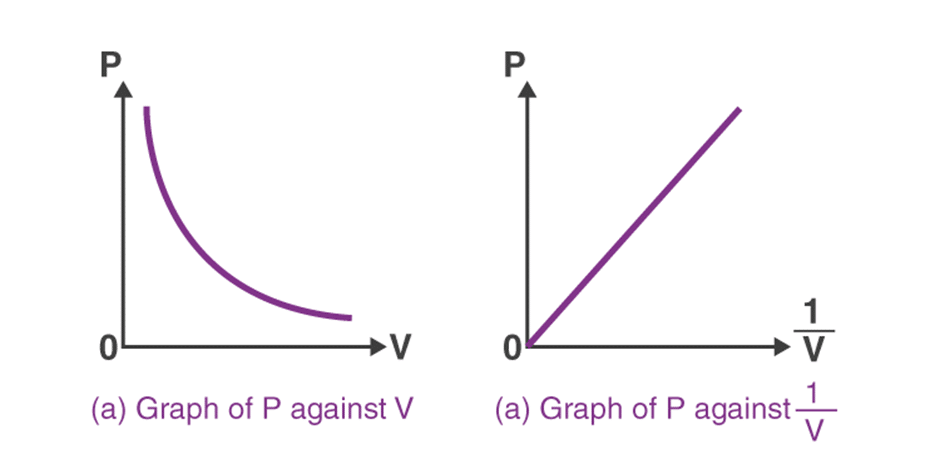
Boyle’s law states that, “at constant temperature, the pressure exerted by a given mass of a gas is inversely proportional to the volume occupied by it.” If P be the pressure exerted by a gas of volume V, then, at constant temperature,
P ∝ [latex]\frac{1}{V}[/latex]
PV = constant
Let, P1 and V1 be the initial pressure and volume of the gas, which is changed to final pressure P2 and V2 at constant temperature T, then, Boyle’s law can be written as,
P1V1 = P2V2 = constant
This is Boyle’s law.
If we plot the graph between P & V, a hyperbolic curve is obtained. Similarly, if we plot the values of P & [latex]\frac{1}{V}[/latex], the following straight line is obtained:
Charles’s law
a. Charles’s law at Constant Pressure (Law of volume)
It states that, “At constant pressure, the volume of the gas increases or decreases by a constant fraction of the volume at 0oC for each degree rise or fall in temperature.”
If Vo be the volume of the gas at 0oC and [latex]V_\theta^oC[/latex] be that at [latex]\theta^oC[/latex] at constant pressure, then, from Charles’s law at constant pressure,
You've reached the end of the free preview. Continue with NN Premium.
- Complete access to every Premium chapter
- Notes, QBank, solutions & MCQs
- Premium PDFs & study resources
- Entrance preparation & mock tests
One NN Premium subscription unlocks everything.
MCQs
- A gas has a pressure P, volume V and temperature 500 K. The pressure is doubled at constant volume and then the volume is reduced to one quarter at constant pressure. The final temperature of the gas in K is
a. 125
b. 250
c. 500
d. 1000 - At constant temperature, the graph of pressure Vs. reciprocal of volume is
a. straight line
b. parabola
c. ellipse
d. circle - Boyle’s law is applicable in
a. isochoric condition
b. isothermal condition
c. isobaric condition
d. isotonic process - At 0 K, which of the following property of gas will be zero?
a. K.E.
b. P.E.
c. mass
d. density - A box contains n molecules of gas. If the number of molecules is increased to 2n, the pressure of gas will
a. become half
b. becomes 4 times
c. remain unchanged
d. become twice - How much should the pressure of a gas be increased to decrease the volume of the gas by 10% at constant temperature?
a. 10%
b. 9.5%
c. 11.11%
d. 5.11 - What is the value of PV/T for one mole of ideal gas?
a. 8.4 cal/molK
b. 4.2 cal/molK
c. 2 cal/molK
d. none of above - A sample of an ideal gas occupies a volume V at a pressure P and absolute temperature T. The mass of each molecule is m. Which of the following expressions gives the density of the gas?
a. mkT
b. Pm/kT
c. P/kTV
d. P/kT - A sample of oxygen have the same mass, volume and pressure as another sample of hydrogen. The ratio of their temperature will be [latex]T_o/T_H[/latex]?
a. 4
b. 8
c. 16
d. 32 - Pressure of a gas at constant volume is proportional to
a. total energy of gas
b. average P.E. of molecules
c. average K.E. of molecules
d. total internal energy of gas
CONCEPTUAL PROBLEMS
- How can Kelvin scale, in principle, be designed by the experiment based on ideal gas law? Explain.
- What physical concept is provided by universal gas constant? Write its unit.
- On reducing the volume of a gas at constant temperature, the pressure of a gas increases. Why?
- What is the difference between a real and an ideal gas? Explain on the basis of the hypothesis of the kinetic theory.
- Do you expect the gas in cooking as cylinder to obey the ideal gas equation?
- What are the characteristics of a gas to be an ideal?
- Why does the cycle tube burst sometimes in summer?
- What does “the kinetic interpretation of temperature” signify? Explain.
- Explain on the basis of kinetic theory that the pressure of a gas increases with increase of temperature.
- At a fixed temperature the volume of a vessel in compressed to half. How will the rms speed of the gas in it change?
- In the kinetic theory of gases, why do we not take into account the changes in gravitational potential energy of the molecule?
- At absolute zero temperature, why is the kinetic energy zero?
- Why do you consider an ideal gas while formulating the pressure in the light of kinetic theory of gases?
- Outline the essential features of the kinetic theory of gases.
- If the pressure of a gas increases by 10%, what is the percentage decrease in volume if Boyle’s law holds good.
Show answer
THEOREY BASED PROBLEMS
Show answer
You've reached the end of the free preview. Continue with NN Premium.
- Complete access to every Premium chapter
- Notes, QBank, solutions & MCQs
- Premium PDFs & study resources
- Entrance preparation & mock tests
One NN Premium subscription unlocks everything.
Numerical 1
Air at 273 K and 1.01 [latex]\times[/latex] 105 Nm-2 pressure contains 2.70 [latex]\times [/latex] 1025 molecules per cubic meter. How many molecules per cubic meter will there be at a place, where the temperature is 223K and the pressure is 1.33 [latex]\times[/latex] 104 Nm-2?
Solution
Given,
Temperature (T1) = 273 K
Pressure (P1) = 1.01 [latex]\times[/latex] 105 Nm-2
No. of molecules per unit volume (n1) = 2.70 [latex]\times[/latex] 1025 molecules/m3
No. of molecules per unit volume at T2 (n2) =?
Temperature (T2) = 223 K
Pressure (P2) = 1.33 [latex]\times[/latex] 104 Nm-2
We know that,
P = [latex]\frac{1}{3}\rho c^2[/latex]
Or, P = [latex]\frac{1}{3}\times \frac{M}{V}\times c^2[/latex]
Or, P = [latex]\frac{1}{3}\times \frac{mN}{V}\times c^2[/latex]
You've reached the end of the free preview. Continue with NN Premium.
- Complete access to every Premium chapter
- Notes, QBank, solutions & MCQs
- Premium PDFs & study resources
- Entrance preparation & mock tests
One NN Premium subscription unlocks everything.