
Rate of Heat Flow
SYLLABUS
Conduction: Thermal conductivity and measurement, Convection, Radiation: Ideal radiator, Black-body radiation, Stefan-Boltzmann law.
What is This Chapter About?
Touch a metal rod with one end in a fire and within seconds your hand feels hot. Hold a piece of wood in the same fire and the end you hold stays cool for much longer. Place your hand near (but not touching) a glowing electric heater and you feel warmth even across an air gap. These three experiences illustrate the three fundamentally different mechanisms by which heat energy travels from one place to another — conduction, convection, and radiation.
Chapter 12 of NEB Grade 11 Physics studies how heat flows — quantitatively — through and between bodies. It introduces the precise mathematical laws governing each mode of heat transfer and connects them to real-world applications ranging from building insulation to the temperature of the Sun. Carrying 5 teaching hours, this chapter has both strong theoretical content and rich practical relevance.
Key Concepts You Will Learn
Conduction
Thermal conduction is the transfer of heat through a material by direct molecular interaction, without any bulk movement of the material itself. When one end of a solid is heated, the molecules there vibrate more energetically and transfer energy to neighbouring molecules through collisions, gradually propagating the heat along the material.
The rate of heat flow by conduction through a slab of material is given by Fourier’s Law:
[latex]\frac{dQ}{dt} = -kA\frac{dT}{dx}[/latex]
where k is the coefficient of thermal conductivity of the material, A is the cross-sectional area, and [latex]\frac{dT}{dx}[/latex] is the temperature gradient — the rate of change of temperature with distance along the material. The negative sign indicates that heat flows in the direction of decreasing temperature.
The coefficient of thermal conductivity k characterises how well a material conducts heat. Metals have high k values (copper: ~400 W m⁻¹ K⁻¹) because free electrons carry thermal energy efficiently. Non-metals and insulators have low k values (glass wool: ~0.04 W m⁻¹ K⁻¹), which is why they are used as building insulation.
Searle’s Method is the standard experimental technique for measuring k for good conductors. A long metal bar is heated at one end by steam and cooled at the other end by flowing water. Thermometers at known positions along the bar measure the temperature gradient, and the flow rate and temperature rise of the cooling water measure the rate of heat transfer. Combining these measurements gives k precisely.
Convection
Thermal convection is the transfer of heat by the bulk movement of a fluid (liquid or gas). When a fluid is heated from below, it expands, becomes less dense, and rises — carrying thermal energy with it. Cooler, denser fluid sinks to replace it, creating a convection current that continuously circulates and distributes heat throughout the fluid.
Convection is the dominant mode of heat transfer in fluids and is responsible for ocean currents, atmospheric circulation, sea breezes, the boiling of water, and the convective zone of the Sun. It cannot occur in solids because the molecules cannot move from place to place.
Radiation
Thermal radiation is the transfer of heat by electromagnetic waves — primarily infrared radiation — that requires no medium and can travel through a vacuum. All objects at any temperature above absolute zero emit thermal radiation. The hotter the object, the more radiation it emits and the shorter the peak wavelength of that radiation (which is why very hot objects glow red, then orange, then white as temperature increases).
Absorption, Reflection, and Transmission
When radiation falls on a surface, it can be absorbed, reflected, or transmitted. The three coefficients satisfy: [latex]a + r + t = 1[/latex], where a is the absorptivity, r is the reflectivity, and t is the transmissivity. A perfect absorber (a = 1) is called a black body — it absorbs all radiation falling on it and reflects none. In practice, a small hole in a cavity acts as an ideal black body.
A perfect black body is also the most efficient emitter of radiation at every wavelength. The emissivity (e) of a surface measures how well it emits radiation compared to a black body at the same temperature — for a black body, e = 1; for all real surfaces, e < 1.
Stefan-Boltzmann Law
The total power radiated per unit area by a black body is given by the Stefan-Boltzmann Law:
[latex]P = \sigma T^4[/latex]
where [latex]\sigma = 5.67 \times 10^{-8}[/latex] W m⁻² K⁻⁴ is the Stefan-Boltzmann constant and T is the absolute temperature in kelvin. The fourth-power dependence on temperature is dramatic — doubling the absolute temperature increases the radiated power by a factor of 16. For a real body with emissivity e and surface area A, the net power radiated is:
[latex]P = e\sigma A(T^4 – T_0^4)[/latex]
where [latex]T_0[/latex] is the temperature of the surroundings.
Estimating the Temperature of the Sun
An elegant application of Stefan’s Law allows us to estimate the apparent surface temperature of the Sun. By measuring the total power received per unit area at the Earth’s surface (the solar constant, approximately 1360 W/m²) and knowing the distance from the Earth to the Sun and the Sun’s radius, we can calculate the total power radiated by the Sun and then use Stefan’s Law in reverse to find the temperature of the solar surface — approximately 5778 K. This beautiful calculation connects laboratory physics to astronomy.
Why This Chapter Matters for NEB Exams
Rate of Heat Flow is examined consistently in NEB Grade 11 Physics. Fourier’s Law of conduction — stating it, applying it, and solving numerical problems — is a standard question. Stefan-Boltzmann Law problems (calculating radiated power or temperature given radiated power) appear regularly. The distinction between the three modes of heat transfer, the definitions of absorptivity, reflectivity, and emissivity, and the principle of Searle’s method are all common short-answer topics. Estimating the Sun’s temperature using Stefan’s Law is a classic application problem.
Important Topics to Focus On
- Three modes of heat transfer — conduction, convection, radiation — with examples
- Fourier’s Law: [latex]\frac{dQ}{dt} = -kA\frac{dT}{dx}[/latex] — definition of thermal conductivity
- Temperature gradient and its role in conduction
- Searle’s method for measuring thermal conductivity — principle and procedure
- Coefficients of absorption, reflection, and transmission: [latex]a + r + t = 1[/latex]
- Ideal radiator (black body) — definition, emissivity = 1
- Stefan-Boltzmann Law: [latex]P = e\sigma A(T^4 – T_0^4)[/latex]
- Emissive power and emissivity of real surfaces
- Estimating the apparent temperature of the Sun using Stefan’s Law
- Numerical problems on thermal conductivity and Stefan’s Law
Connection to Other Chapters
Rate of Heat Flow builds on Chapter 9 (Heat and Temperature) — heat flows because of temperature differences — and Chapter 11 (Quantity of Heat) — the heat transferred is quantified using specific heat capacity and latent heat. The concept of radiation connects to Chapter 13 (Ideal Gas) through blackbody radiation and molecular energy, and to Grade 12 Chapter 21 (Photons), where the quantum nature of radiation is explored. Stefan’s Law connects forward to Grade 12 thermodynamics through the concept of entropy and disorder. The variation of density with temperature studied in Chapter 10 (Thermal Expansion) drives the convection currents described here.
Introduction
There are 3 modes by which heat is transferred:
i. Conduction
ii. Convection and
iii. Radiation
i. Conduction
The transfer of heat within a medium from one point to another without actual movement of molecules is called conduction. It is carried by means of collision between the vibrating molecules. It is applicable in solid only.
Thermal Conductivity (K)
The measure of ability of solid to conduct heat through it is called thermal conductivity. Let us consider a solid rod of length [latex](l)[/latex] and cross-sectional area (A), whose one face is maintained at higher temperature [latex]\theta_1[/latex] and other face is maintained at lower temperature [latex]\theta_2[/latex].
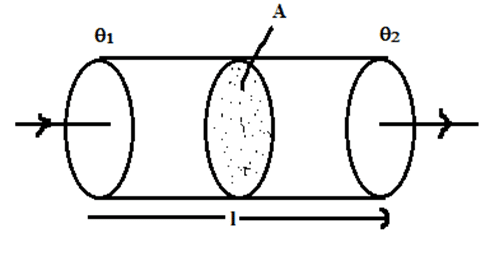
It has been found that, the quantity of heat (Q) flowing through the rod is:
- Directly proportional to the cross-sectional area. i.e., Q ∝ A
- Directly proportional to the temperature difference between the ends of the conductor. i.e., Q ∝ [latex](\theta_1 – \theta_2)[/latex]
- Inversely proportional to the separation between the two faces. i.e., [latex]Q\propto \frac{1}{l}[/latex]
- Directly proportional to the time for which heat flows. i.e., Q ∝ t
Combining all, we get,
Q ∝ [latex]\frac{A(\theta_1 – \theta_2)t}{l}[/latex]
You've reached the end of the free preview. Continue with NN Premium.
- Complete access to every Premium chapter
- Notes, QBank, solutions & MCQs
- Premium PDFs & study resources
- Entrance preparation & mock tests
One NN Premium subscription unlocks everything.
MCQs
- If the absolute temperature of a radiating body is suddenly halved, the radiating power will reduce approximately by
a. 25%
b. 12.5%
c. 6.25%
d. 3.12% - Which relation for emissive power and temperature is correct?
a. [latex]E\propto T[/latex]
b. [latex]E\propto T^2[/latex]
c. [latex]E\propto T^4[/latex]
d. [latex]E\propto T^{-4}[/latex] - The most appropriate material for making a cooking pot is the one having
a. Low specific heat and high conductivity
b. Low specific heat and low conductivity
c. High specific heat and low conductivity
d. High specific heat and high conductivity - Two stars radiate maximum energy at 320 nanometer and 400 nanometer respectively. The ratio of their Kelvin temperature is
a. 5:4
b. 4:5
c. 2:5
d. 4:25 - Instrument used to measure temperature by radiation method is
a. Pyrometer
b. Radio micrometer
c. Thermometer
d. Barometer - The ratio of maximum wavelength of sun and moon is in the ratio 1:4000. What is the ratio of their temperature?
a. 200:1
b. 400:1
c. 1:200
d. 1:400 - Unit of the coefficient of thermal conductivity is
a. [latex]watt\ Km^{-1}[/latex]
b. [latex]Joule\ sK^{-1}[/latex]
c. [latex]watt\ K^{-1}m^{-1}[/latex]
d. [latex]Joule\ s^{-1}K[/latex] - If temperature of black body is increased by 50% percentage increase in emitted radiation
a. 50
b. 100
c. 500
d. 400 - From 0oC the coefficient of thermal expansion of water is
a. Positive but not zero
b. negative
c. zero
d. Infinite - A black body is heated from 27oC to 127oC the ratio of their energies of radiation is
a. 9:16
b. 27:64
c. 81:256
d. 3:4 - A perfectly black body emits radiation at temperature [latex]T_1K[/latex]. If it is to radiate 16 times this power, its temperature [latex]T_2K[/latex] will be
a. [latex]T_2 = 16T_1[/latex]
b. [latex]T_2 = 8T_1[/latex]
c. [latex]T_2 = 4T_1[/latex]
d. [latex]T_2 = 2T_1[/latex] - Two rods of same length and diameter having thermal conductivities 2 and 3 units respectively are joined in series. The equivalent thermal conductivity is
a. 1.0
b. 2.0
c. 3.0
d. none
CONCEPTUAL PROBLEMS
- Cooking utensils are blackened at the bottom and polished on the upper surface. Explain, why?
- What is the physical meaning of emissivity? Write its unit.
- Why are the polar regions much cooler than the equatorial regions despite the fact that the polar regions are periodically tilted towards sun?
- Air is a bad conductor of heat. Why do you feel cool without cloth in your body?
- Although aluminium is good conductor of heat, how can aluminium foil with shining surface can be used to keep food hot for a long time?
- Birds often swell their feathers in winter. Why?
- Animals curl into a ball, when they feel very cold. Why?
- Why are two thin blankets warmer than a single blanket of double the thickness?
- Why are good absorbers always good emitters?
- What is a blackbody? How is it realized in practice?
- How are water pipes used in the room painted black?
- Metal knob of door is colder than wooden parts at the same temperature. Why?
Show answer
THEORY BASED PROBLEMS
Show answer
You've reached the end of the free preview. Continue with NN Premium.
- Complete access to every Premium chapter
- Notes, QBank, solutions & MCQs
- Premium PDFs & study resources
- Entrance preparation & mock tests
One NN Premium subscription unlocks everything.
A bar 0.2 m in length and 2.5 cm2 in cross section is ideally lagged. One end is maintained at 100oC and the other end is maintained at 0oC by immersing in melting ice. Calculate the mass of ice melt in one hour. Thermal conductivity of the material of the bar is 4 x 10² Wm-1K-1.
Solution
Length of bar (l) = 0.2 m
Cross section area (A) = 2.5 cm2 = 2.5 x 10⁻⁴ m2
Temperature of one end [latex](\theta_1)[/latex] = 100oC
Temperature of other end [latex](\theta_2)[/latex] = 0oC
Mass of ice melted (m) =?
Time (t) = 1 hour = 60 x 60 = 3600 s
Thermal conductivity of the material of the bar (K) = 4 x 10² Wm-1K-1
We know that,
Q1 = [latex]\frac{KA(\theta_1 – \theta_2)t}{l}[/latex] …………………. (i)
Also, quantity of heat required to melt ice
Q2 = mLf ……………. (ii)
You've reached the end of the free preview. Continue with NN Premium.
- Complete access to every Premium chapter
- Notes, QBank, solutions & MCQs
- Premium PDFs & study resources
- Entrance preparation & mock tests
One NN Premium subscription unlocks everything.