
Heat and Temperature
SYLLABUS
Molecular concept of thermal energy, heat and temperature, and cause and direction of heat flow, Meaning of thermal equilibrium and Zeroth law of thermodynamics, Thermal equilibrium as a working principle of mercury thermometer.
What is This Chapter About?
Feel the warmth of sunlight on your skin. Touch a metal spoon left in hot soup and pull your hand back instinctively. Watch steam rise from a boiling kettle. All of these experiences involve heat — the transfer of thermal energy from one body to another. Yet despite how familiar heat feels, its precise scientific definition is surprisingly subtle, and confusing it with temperature leads to significant misunderstandings.
Chapter 9 of NEB Grade 11 Physics opens the Heat and Thermodynamics section of the course by establishing the most fundamental concepts: what heat actually is at the molecular level, how it differs from temperature, what thermal equilibrium means, and how thermometers work. Carrying 3 teaching hours, this chapter is compact but conceptually essential — it lays the language and framework that all subsequent heat chapters depend on.
Key Concepts You Will Learn
Molecular Concept of Thermal Energy, Heat, and Temperature
All matter is made of atoms and molecules in constant random motion. The total kinetic and potential energy associated with this random microscopic motion is called the internal energy or thermal energy of the substance. The faster the molecules move on average, the greater the thermal energy.
Temperature is a measure of the average kinetic energy of the molecules of a substance. It tells us how hot or cold something is — but it says nothing about how much thermal energy the substance contains. A large cup of warm water can contain more thermal energy than a small cup of boiling water, even though the boiling water is at a higher temperature.
Heat is energy in transit — it is thermal energy flowing from a region of higher temperature to a region of lower temperature. Heat is not a property that a body possesses; it is a process of energy transfer. This distinction — that heat is energy being transferred, not energy being stored — is one of the most important conceptual clarifications in all of thermal physics.
The direction of heat flow is always from higher temperature to lower temperature, never the reverse spontaneously. This is the microscopic basis of what will later become the Second Law of Thermodynamics.
Thermal Equilibrium and the Zeroth Law
When two bodies at different temperatures are brought into contact, heat flows from the hotter to the cooler body. Over time, the temperatures of both bodies approach each other until they become equal — at this point, heat flow stops and the system is said to be in thermal equilibrium.
The Zeroth Law of Thermodynamics formalises this observation: if body A is in thermal equilibrium with body C, and body B is also in thermal equilibrium with body C, then A and B are in thermal equilibrium with each other. This seemingly simple statement has profound implications — it establishes that temperature is a well-defined, measurable quantity, and that all bodies in thermal equilibrium share the same temperature regardless of their composition, size, or shape.
The Zeroth Law is so fundamental that it was recognised after the First and Second Laws were already established — hence the unusual name. It is numbered “zeroth” because it logically precedes the others.
Thermal Equilibrium as the Working Principle of a Mercury Thermometer
A mercury thermometer works directly on the principle of thermal equilibrium. When the thermometer is placed in contact with an object, heat flows between them until they reach the same temperature — thermal equilibrium. At this point, the length of the mercury column no longer changes, and the temperature can be read from the calibrated scale.
The mercury expands uniformly with temperature (in the range where it remains liquid), so the length of the mercury column provides a reliable, reproducible measure of temperature. The thermometer reading is meaningful precisely because of the Zeroth Law — when the thermometer reaches equilibrium with the object, both are at the same temperature, and the thermometer’s reading reflects the object’s temperature.
Why This Chapter Matters for NEB Exams
Although Chapter 9 carries only 3 teaching hours, its concepts are foundational and appear as short-answer questions in NEB examinations. The distinction between heat and temperature is a classic conceptual question. The statement and significance of the Zeroth Law of Thermodynamics is frequently examined. Explaining how a mercury thermometer works using the principle of thermal equilibrium is a standard short-answer question. Students who understand this chapter clearly find the subsequent heat chapters — Thermal Expansion, Quantity of Heat, Rate of Heat Flow, and Ideal Gas — significantly more coherent.
Important Topics to Focus On
- Molecular interpretation of thermal energy — random kinetic and potential energy of molecules
- Precise distinction between heat, temperature, and internal energy
- Direction of heat flow — always from higher to lower temperature
- Definition of thermal equilibrium — when two bodies stop exchanging heat
- Statement of the Zeroth Law of Thermodynamics
- Significance of the Zeroth Law — establishes temperature as a measurable quantity
- Working principle of a mercury thermometer based on thermal equilibrium
- Why the same object can have different amounts of heat energy at different temperatures
Connection to Other Chapters
Chapter 9 provides the conceptual vocabulary for all subsequent heat chapters. Chapter 10 (Thermal Expansion) uses temperature change to quantify expansion. Chapter 11 (Quantity of Heat) introduces specific heat capacity — the amount of heat needed to change a body’s temperature. Chapter 12 (Rate of Heat Flow) studies how heat transfers through conduction, convection, and radiation. Chapter 13 (Ideal Gas) connects temperature to the average kinetic energy of gas molecules through the kinetic theory. In Grade 12, the First and Second Laws of Thermodynamics build directly on the foundation laid here — and the Zeroth Law’s establishment of temperature as a state variable is implicitly used throughout all thermodynamics.
Heat
When we touch a cup of tea, we feel hot and when we touch an ice, we feel cold. We feel hotness when our body gains some energy from another body and coldness is due to the flow of energy from our body to another body. Thus, heat is “the form of energy that flows from one body to another producing the sensation of hotness and coldness”.
When we supply heat to any object, the K.E. of the molecules of the object increases. So, total sum of K.E. of all the molecules of any object gives heat energy of that object.
Dynamic Theory of Heat
In this theory, all the substances are made of molecules and they are in random motion. The motion of molecules is of three types:
i. Translatory: It is the motion in which molecules move in a straight line. It is common in gases.
ii. Vibratory: It is the to and fro motion of the molecules about their mean position. It is common in solids and liquids.
iii. Rotatory: It is the rotation of molecules about their axes. It occurs at high temperature.
So, heat is the form of energy that remains in the body as total energy due to these motion of the molecules of the body.
Temperature
Temperature is the fundamental physical quantity which measures the degree of hotness or coldness of a body. The heat flows from higher temperature to lower temperature. In another way, temperature is the measure of average K.E. of a molecule. It can be measured in different scales like Celsius (oC), Fahrenheit (oF), Kelvin (K), Reaumer (oR) and Rankine (oRn). Among them, Kelvin (K) is the SI unit of temperature.
Unit of Heat Energy
In C.G.S. system, unit of heat energy is calorie (Cal). Whereas, the SI unit of heat energy is Joule (J). The relation between calorie and Joule is: 1 Cal = 4.18 J.
Differences between Heat and Temperature
| Heat | Temperature |
| 1. Heat is the form of energy which produces the sensation of hotness or coldness on our body. | 1. Temperature is the measure of degree of hotness or coldness of a body. |
| 2. It is the cause on a body. | 2. It is the effect on a body. |
| 3. Two bodies in thermal equilibrium, may or may not have the same amount of heat. | 3. Two bodies in thermal equilibrium, must have the same temperature. |
| 4. Heat flowing from one body to another is independent of the amount of the heat contained on them. | 4. Heat flowing from one body to another depends on the temperature. |
| 5. It is the total K.E. of all the molecules of the body. | 5. It is the average K.E. of a molecule of a body. |
Effects of Heat
The effects of heat are as follows:
i. Rise in Temperature
If heat is supplied on a body, in general, its temperature rises. However, in case of phase change (changing from solid to liquid and liquid to vapour), remains constant temperature even if heat is supplied.
ii. Rise in volume
If heat is supplied on a body, its length, breadth is increased. Thus, the volume on a body increases.
iii. Change of state of matter
If we apply heat, on a body, its state is changed. For example, if heat is applied on ice, it changes into liquid and liquid is changed into gases. So, heat changes the state of matter.
iv. Change in electric properties
If heat is supplied on a body, its temperature increases. Increase of temperature of pure metals increases the resistance of the metal.
v. Change in physical and chemical properties:
Increase of temperature on a body, causes the change in physical and chemical properties.
vi. Generation of light:
Increase of temperature, on a body, causes the generation of light.
Thermal Equilibrium
If two bodies at two different temperatures are kept in contact, heat flows from a body at higher temperature to another body at lower temperature and it continues till their temperature becomes equal and net flow of heat between them is zero. This state of equality in temperature is called thermal equilibrium.
Zeroth Law of Thermodynamics
It states that, “When two systems are separately in thermal equilibrium with a third system, then they must be in thermal equilibrium with each other.” To explain this, let us consider, three systems A, B and C in which A and B are separated by non – conducting (insulating) wall while a conducting wall separates C from A and B.
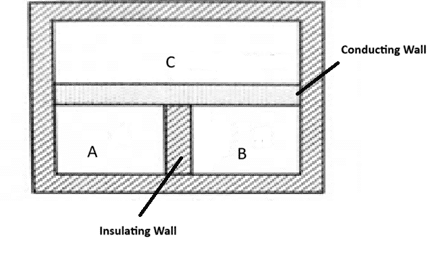
If they are let as it is, heat flows between A and C and between B and C until they attain thermal equilibrium. i.e. TA= TC and TB = TC. This implies, TA = TB.
When the insulating wall between A and B is replaced by a conducting wall, no heat flows between A and B, which shows that A and B are also in thermal equilibrium. This proves the zeroth law of thermodynamics.
Thermometry
The branch of physics, which deals with the measurement of temperature of a body is called thermometry. Thermometer is the instrument which is used to measure temperature of a body.
Different Temperature Scales
The following are the temperature scales:
a. Celsius Scale
The lower fixed point (ice point) of Celsius scale is 0oC & upper fixed point (steam point) is 100oC. The region between them is divided into 100 equal parts and each part is called 1oC.
b. Fahrenheit Scale
The lower fixed point of Fahrenheit scale is 32oF & upper fixed point is 212oF. The region between them is divided into 180 equal parts & each part is called 1oF.
c. Kelvin Scale
The lower fixed point of Kelvin scale is 273K & upper fixed point of the scale is 373K. The region between them is divided into 100 equal parts & each part is called 1K.
d. Reaumer Scale
The lower fixed point of Reaumer scale is 0oR & upper fixed point is 80oR. The region between them is divided into 80 equal parts & each part is called 1oR.
e. Rankine Scale
The lower fixed point of Rankine scale is 492oRn & upper fixed point is 672oRn. The region between them is divided into 180 equal parts & each part is called 1oRn.
Relation between different Temperature scales
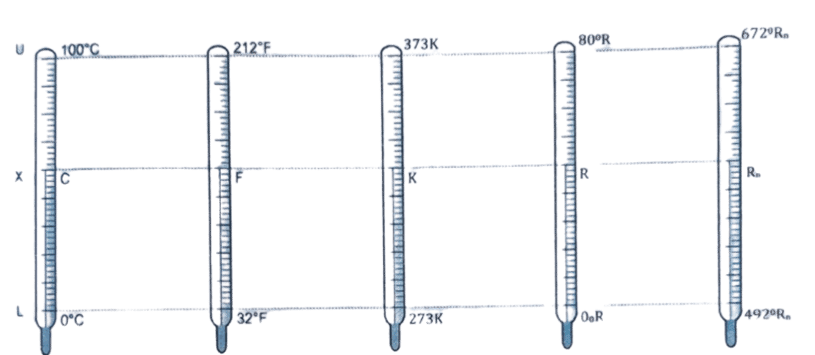
Consider, five thermometers in Celsius, Fahrenheit, Kelvin, Reaumer and Rankine are kept in a warm water & the corresponding readings are C, F, K and R and Rn respectively as shown in the given figure.
We know,
[latex]\frac{X – L}{U – L} = \frac{C-0}{100-0} = \frac{F-32}{212-32}=\frac{K-273}{373-273} = \frac{R-0}{80-0} = \frac{R_n – 492}{672-492}[/latex]
Or, [latex]\frac{C}{100} = \frac{F-32}{180} = \frac{K-273}{100} = \frac{R}{80} = \frac{R_n – 492}{180}[/latex] is the required relation.
Absolute Zero Temperature
Absolute zero is the lowest possible temperature where heat energy is absent in a substance. Absolute zero is also known as zero kelvin temperature since it measures zero on the Kelvin scale.
Note: The value of the absolute zero is -459.67 degrees Fahrenheit on the Fahrenheit scale and -273.15 degrees Celsius on the Celsius scale. The lowest temperature a thermodynamic system can withstand is -459.67 degrees Fahrenheit and -273.15 degrees Celsius. The absolute zero temperature is a theoretical value.
Advantages of using mercury as Thermometric Substance
1. It has a low specific heat capacity and hence it absorbs little heat from the body.
2. It is a good conductor of heat and attains the temperature quickly.
3. It does not wet the wall of the glass tube.
4. Mercury is shinny and silvery white in color. So, reading can be made easily.
5. It can measure large range of temperatures from -39oC to 357oC.
MCQs
Temperature is a measure of
Show answer
The density of water is maximum at
Show answer
If in winter season, the surface temperature of lake is 1oC, the temperature at the bottom of lake will be
Show answer
In engines, water is used as coolant, because
Show answer
Theoretical questions
A student claimed that thermometers are useless because a thermometer always registers its own temperature. How would you respond?
Define absolute temperature
Why mercury is used in thermometer?
Which physical quantity determines the direction of flow of heat?
What are the differences between heat and temperature?
Define temperature on the basis of Zeroth law of thermodynamics.
State and explain Zeroth law of thermodynamics.
Explain about different temperature scales.
Numerical problems
Express 98oF into Kelvin scale. Ans: 309.67 K
At what temperature will the Kelvin scale reading double the Fahrenheit reading? Ans: 176.69oF or 353.38K
At what temperature, do the Fahrenheit-thermometer and Celsius-thermometer show the same reading? Ans: – 40oC
At what point of thermometric scale does kelvin scale reading coincide with Fahrenheit scale reading? Ans: 574.25K
A centigrade thermometer reads 1oC at the melting point of ice and 99oC at the boiling point of water at normal pressure. What is the correct temperature when it reads 25oC? Ans: 24.5oC
A faulty Fahrenheit thermometer shows a temperature of 206oF when immersed in boiling water. When a correct Celsius thermometer is dipped in the same water it records 96oC. Find the correction to be applied to the faulty thermometer? Ans: – 1.2oF
What is the change in Fahrenheit scale when the temperature change in Centigrade scale is 12.5? Ans: 22.5oF
Express 98oF into Kelvin scale.
Solution
F = 98oF
K =?
We know that,
[latex]\frac{F-32}{180} = \frac{K-273}{100}[/latex]
Or, [latex]\frac{98-32}{18} = \frac{K-273}{10}[/latex]
Or, [latex]\frac{66}{18} = \frac{K-273}{10}[/latex]
Or, 660 = 18K – 4914
Or, 18K = 660 + 4914
Or, 18K = 5574
Or, K = 309.67 K
At what temperature will the Kelvin scale reading double the Fahrenheit reading?
Solution
Let, Fahrenheit reading (F) = x
So, Kelvin reading (K) = 2x
We know that,
[latex]\frac{F-32}{180} = \frac{K-273}{100}[/latex]
Or, [latex]\frac{x-32}{180} = \frac{2x-273}{100}[/latex]
Or, [latex]\frac{x-32}{9} = \frac{2x-273}{5}[/latex]
Or, 18x – 2457 = 5x – 160
Or, 13x = 2297
Or, x = 176.69
So, required answer is: 176.69oF or 353.38K
At what temperature, do the Fahrenheit-thermometer and Celsius-thermometer show the same reading?
Solution
Let, Fahrenheit reading (F) = x
So, Celsius reading (C) = x
We know that,
[latex]\frac{F-32}{180} = \frac{C}{100}[/latex]
Or, [latex]\frac{x-32}{180} = \frac{x}{100}[/latex]
Or, [latex]\frac{x-32}{9} = \frac{x}{5}[/latex]
Or, 5x – 160 = 9x
Or, – 4x = 160
Or, x = – 40oC
At what point of thermometric scale does Kelvin scale reading coincide with Fahrenheit scale reading?
Solution
Point where Kelvin and Fahrenheit scale reading coincides =?
i.e., K = F = x let,
Using formula,
[latex]\frac{F-32}{180} = \frac{F-273}{100}[/latex]
Or, [latex]\frac{x-32}{18} = \frac{x-273}{10}[/latex]
Or, 10x – 320 = 18x – 4914
Or, – 320 + 4914 = 18x – 10x
Or, 4594 = 8x
Or, x = 574.25K
A centigrade thermometer reads 1oC at the melting point of ice and 99oC at the boiling point of water at normal pressure. What is the correct temperature when it reads 25oC? Ans: 24.5oC
Solution:
Faulty Thermometer
LFP = 1oC
UFP = 99oC
Reading shown = 25oC
Correct Thermometer
LFP = 0oC
UFP = 100oC
Reading shown = C
We know,
[latex]\frac{X-L}{U-L} = \frac{C-0}{100-0}[/latex]
Or, [latex]\frac{25-1}{99-1} = \frac{C}{100}[/latex]
Or, [latex]\frac{24}{98} = \frac{C}{100}[/latex]
Or, C = [latex]\frac{2400}{98} = 24.49^o\ C[/latex]
A faulty Fahrenheit thermometer shows a temperature of 206oF when immersed in boiling water. When a correct Celsius thermometer is dipped in the same water it records 96oC. Find the correction to be applied to the faulty thermometer.
Solution
Correct temperature on Celsius thermometer (C) = 96oC
We know,
[latex]\frac{C}{100} = \frac{F-32}{180}[/latex]
Or, [latex]\frac{96}{5} = \frac{F-32}{9}[/latex]
Or, 5F – 160 = 864
Or, F = 204.8oF
So, correct temperature on Fahrenheit scale = 204.8oF
[latex]\therefore[/latex] Correction to be applied = 206 – 204.8 = 1.2oF
What is the change in Fahrenheit scale when the temperature change in Centigrade scale is 12.5?
Solution
Change in Fahrenheit scale [latex](\Delta F)[/latex] =?
Change in centigrade scale [latex](\Delta C)[/latex] =?
We have,
[latex]\frac{F-32}{180} = \frac{C}{100}[/latex]
Or, [latex]\frac{F-32}{9} = \frac{C}{5}[/latex]
Or, C = [latex]\frac{5}{9}(F-32)[/latex]
So, [latex]\Delta C = \frac{5}{9}(\Delta F)[/latex]
Or, [latex]\Delta F = \frac{9}{5}\times 12.5 = 22.5^o F[/latex]
Test what you’ve learned in this chapter with a quick self-graded quiz.
Start MCQ Quiz