
Circular Motion
SYLLABUS
Angular displacement, velocity and acceleration, Relation between angular and linear velocity and acceleration, Centripetal acceleration, Centripetal force, Conical pendulum, Motion in a vertical circle, Applications of banking.
What is This Chapter About?
When an object moves in a straight line, its direction stays constant. But what happens when an object moves along a curved path — specifically, a circular one? A car turning a corner, a satellite orbiting Earth, a stone whirled on a string, a motorcycle on a banked road — all of these involve circular motion, and they reveal something surprising: even when speed is constant, an object moving in a circle is always accelerating.
This apparent paradox — acceleration without change in speed — is the central insight of Chapter 6. It arises because acceleration is a vector, and a change in direction is just as much an acceleration as a change in speed. Understanding this deeply transforms how students think about motion and force.
Chapter 6 of NEB Grade 11 Physics carries 6 teaching hours and is examined consistently, with applications ranging from conical pendulums to banked roads appearing in almost every board paper.
Key Concepts You Will Learn
Angular Quantities
Circular motion is most naturally described using angular quantities. Angular displacement ([latex]\theta[/latex]) is the angle swept by the radius in a given time, measured in radians. Angular velocity ([latex]\omega[/latex]) is the rate of change of angular displacement: [latex]\omega = \frac{d\theta}{dt}[/latex]. Angular acceleration ([latex]\alpha[/latex]) is the rate of change of angular velocity: [latex]\alpha = \frac{d\omega}{dt}[/latex].
These angular quantities are directly related to their linear counterparts. The linear velocity of a point on a rotating body is [latex]v = r\omega[/latex], and the linear (tangential) acceleration is [latex]a_t = r\alpha[/latex]. These relations connect circular motion to the kinematics studied in Chapter 3.
Centripetal Acceleration and Centripetal Force
For an object moving in a circle at constant speed, the direction of velocity changes continuously. This change in direction requires an acceleration always directed toward the centre of the circle — called centripetal acceleration: [latex]a_c = \frac{v^2}{r} = r\omega^2[/latex].
By Newton’s second law, this acceleration requires a net inward force — the centripetal force: [latex]F_c = \frac{mv^2}{r} = mr\omega^2[/latex]. It is crucial to understand that centripetal force is not a new type of force — it is simply the name given to whatever force (tension, gravity, friction, normal reaction) is providing the inward acceleration in a particular situation.
Motion in a Vertical Circle
When an object moves in a vertical circle — like a ball on a string or a roller coaster loop — both gravity and tension contribute to the centripetal force, but their relative contributions change at every point. At the top of the circle, both tension and gravity point inward: [latex]T + mg = \frac{mv^2}{r}[/latex]. At the bottom, tension points inward but gravity points outward: [latex]T – mg = \frac{mv^2}{r}[/latex]. The minimum speed at the top for maintaining circular motion is [latex]v_{min} = \sqrt{gr}[/latex], where tension becomes zero.
Conical Pendulum
A conical pendulum consists of a mass attached to a string that traces out a horizontal circle while the string makes a constant angle [latex]\theta[/latex] with the vertical. The tension in the string provides both the vertical support (balancing gravity) and the horizontal centripetal force. The time period is: [latex]T = 2\pi\sqrt{\frac{l\cos\theta}{g}}[/latex], where [latex]l[/latex] is the length of the string. This is a beautiful application that combines equilibrium and circular motion analysis.
Banking of Roads
When a vehicle moves around a curved road, friction provides the centripetal force on a flat road. However, relying on friction alone is dangerous, especially at high speeds or on wet roads. Banking — tilting the road surface inward — allows the normal reaction force to provide the centripetal force without any friction. The ideal banking angle satisfies: [latex]\tan\theta = \frac{v^2}{rg}[/latex]. This explains why highways are banked at curves and why racing tracks have steeply banked bends.
Why This Chapter Matters for NEB Exams
Circular Motion is examined in every NEB Grade 11 paper. Derivation of centripetal acceleration, analysis of motion in a vertical circle, the conical pendulum period, and banking of roads are all standard examination topics. Numerical problems involving centripetal force, minimum speed in vertical circles, and banking angles appear consistently. Students who understand this chapter well find the Gravitation chapter (satellites and orbital motion) significantly easier.
Important Topics to Focus On
- Definitions and relations between angular and linear quantities
- Derivation of centripetal acceleration: [latex]a_c = \frac{v^2}{r}[/latex]
- Centripetal force — what it is, what provides it in different situations
- Analysis of motion in a vertical circle — tension at top, bottom, and any point
- Minimum speed at the top of a vertical circle
- Conical pendulum — derivation of time period
- Banking of roads — derivation of banking angle [latex]\tan\theta = \frac{v^2}{rg}[/latex]
- Numerical problems on all of the above
Connection to Other Chapters
Circular Motion builds directly on Chapter 3 (Kinematics) and Chapter 4 (Dynamics) — it applies Newton’s second law to circular paths. It connects forward to Chapter 7 (Gravitation), where gravitational force provides centripetal force for satellites. In Grade 12, the angular quantities introduced here (angular velocity, angular acceleration) reappear in Chapter 1 (Rotational Dynamics) as the foundation of rotational mechanics. The conical pendulum also connects to Chapter 2 (Periodic Motion) through its period formula.
Conical Pendulum:
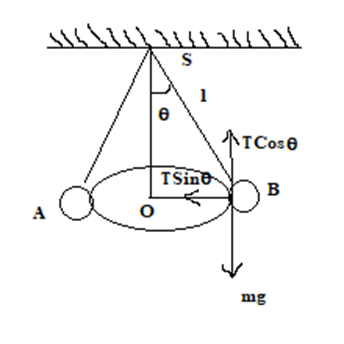
A conical pendulum consists of a heavy bob suspended by perfectly flexible inextensible and massless string from a rigid support so that the bob moves in a horizontal plane with uniform speed and the string sweeps over the surface of cone.
Suppose, a heavy bob of mass ‘m’ is suspended by a fine silk thread of effective length ‘l’ from the rigid support ‘s’. suppose, the bob is moving in a horizontal circle of radius ‘r’ with uniform speed ‘v’ so that the thread makes an angle [latex]\theta[/latex] with the vertical.
From the figure, [latex]\Delta SOB[/latex],
[latex]\sin\theta = \frac{r}{l}[/latex]
Or, [latex]r = l\sin\theta[/latex] ………….. (i)
Let ‘T’ be the tension on the thread and its rectangular are [latex]T\cos\theta[/latex] and [latex]T\sin\theta[/latex]. The component [latex]T\cos\theta[/latex] balances the weight of the bob i.e., mg and [latex]T\sin\theta[/latex] is directed towards the centre which gives necessary centripetal force for the circular motion. Therefore,
[latex]T\cos\theta = mg[/latex] …….. (ii)
[latex]T\sin\theta = \frac{mv^2}{r}[/latex] ……………… (iii)
Dividing [latex]eq^n[/latex] (iii) by (ii), we get,
[latex]\tan\theta = \frac{v^2}{rg}[/latex]
Or, [latex]v = \sqrt{rg\tan\theta}[/latex] …………. (iv)
The time period of the pendulum is defined as the time taken to complete one rotation and is described by:
You've reached the end of the free preview. Continue with NN Premium.
- Complete access to every Premium chapter
- Notes, QBank, solutions & MCQs
- Premium PDFs & study resources
- Entrance preparation & mock tests
One NN Premium subscription unlocks everything.
A bob of mass 200 gram is whirled in a horizontal circle of radius 50 cm by a string inclined at [latex]30^o[/latex] to the vertical. Calculate the tension in the string and the speed of the bob in the horizontal circle.
Solution
Given,
Mass of bob (m) = 200 gm = 0.2 kg
Radius (r) = 50 cm = 0.5 kg
Angle of inclination [latex]\theta = 30^o[/latex]
Tension (T) =?
Speed of the bob (v) =?

We know that,
[latex]T\cos\theta = mg[/latex]
[latex]T\cos30^o = 0.2 \times 10[/latex]
You've reached the end of the free preview. Continue with NN Premium.
- Complete access to every Premium chapter
- Notes, QBank, solutions & MCQs
- Premium PDFs & study resources
- Entrance preparation & mock tests
One NN Premium subscription unlocks everything.