
Dynamics
SYLLABUS
Linear momentum, Impulse, Conservation of linear momentum, Application of Newton’s laws, Moment, torque and equilibrium, Solid friction: Laws of solid friction and their verifications.
What is This Chapter About?
Kinematics told us how objects move. Dynamics asks why they move — and more importantly, why they change their motion. The answer, as Isaac Newton showed in the 17th century, lies in force.
Dynamics is the study of the relationship between force and motion. It is built on Newton’s three laws of motion, which remain among the most powerful and far-reaching statements in all of science. From the motion of a cricket ball to the orbit of a satellite, from the friction between your shoes and the floor to the recoil of a gun — all of it is explained by the principles developed in this chapter.
Chapter 4 carries 6 teaching hours and is a cornerstone of NEB Grade 11 Physics. The concepts here are not just examined directly — they underpin almost every other chapter in the course.
Key Concepts You Will Learn
Linear Momentum and Impulse
The linear momentum of an object is defined as the product of its mass and velocity:
[latex]\vec{p} = m.\vec{v}[/latex]
It is a vector quantity. Impulse is the product of force and the time for which it acts:
[latex]J = F \cdot t[/latex]
The impulse-momentum theorem states that the impulse acting on a body equals the change in its momentum:
[latex]F \cdot t = \Delta p[/latex]
This explains why a cricket fielder pulls their hands back while catching — increasing the time of impact reduces the force experienced.
Newton’s Laws of Motion
Newton’s First Law states that a body remains at rest or in uniform motion unless acted upon by an external force — this is the law of inertia. Newton’s Second Law defines force as the rate of change of momentum:
[latex]F = \frac{dp}{dt} = ma[/latex]
for constant mass. Newton’s Third Law states that every action has an equal and opposite reaction — forces always occur in pairs.
Conservation of Linear Momentum
Using Newton’s second and third laws together, it can be proven that the total linear momentum of an isolated system — one with no external forces — remains constant. This principle of conservation of linear momentum is one of the fundamental conservation laws of physics. It explains rocket propulsion, recoil of guns, and collisions between billiard balls.
Moment of a Force and Torque
When a force acts at a distance from a pivot point, it produces a moment or torque — a turning effect. The moment of a force is
[latex]\tau = F \times d[/latex]
where [latex]d[/latex] is the perpendicular distance from the pivot to the line of action of the force. A couple consists of two equal, parallel, opposite forces separated by a distance — it produces pure rotation without translation.
Principle of Moments and Equilibrium
The principle of moments states that for a body in rotational equilibrium, the sum of clockwise moments equals the sum of anticlockwise moments about any point. For complete equilibrium of a body, two conditions must be satisfied: the net force must be zero (translational equilibrium) and the net torque must be zero (rotational equilibrium).
Friction
When two surfaces are in contact and one slides or tends to slide over the other, a resistive force called friction acts along the surface opposing the motion. The laws of solid friction state that friction is proportional to the normal reaction force and independent of the area of contact. The coefficient of friction
[latex]\mu = \tan\lambda[/latex]
, where
[latex]\lambda[/latex]
is the angle of repose — the maximum angle of inclination at which an object just begins to slide. This elegant result connects friction to a simple geometric measurement.
Why This Chapter Matters for NEB Exams
Dynamics is examined heavily in every NEB Grade 11 paper. Questions on conservation of momentum, Newton’s laws, equilibrium conditions, and friction are standard. Deriving that [latex]\mu = \tan\lambda[/latex] is a classic examination derivation. Numerical problems on impulse, momentum, and equilibrium appear regularly. This chapter also provides the conceptual foundation for Circular Motion, Gravitation, and Rotational Dynamics in Grade 12.
Important Topics to Focus On
- Definitions of momentum and impulse with the impulse-momentum theorem
- Newton’s three laws with proofs and applications
- Derivation and applications of conservation of linear momentum
- Moment of a force and torque of a couple
- Conditions for translational and rotational equilibrium
- Laws of solid friction and their experimental verification
- Proof that
[latex]\mu = \tan\lambda[/latex]
Numerical problems on all topics above
Connection to Other Chapters
Dynamics is the engine of classical mechanics. It connects directly to Chapter 5 (Work, Energy and Power) — forces do work and transfer energy. Chapter 6 (Circular Motion) applies Newton’s second law to circular paths. Chapter 7 (Gravitation) applies Newton’s laws to orbital motion. In Grade 12, Rotational Dynamics is essentially Newton’s second law rewritten for rotating bodies. Understanding Dynamics deeply makes all of these chapters significantly easier.
State of body
1. Rest
A body is said to be at rest if it does not change its position with respect to surrounding.
2. Motion
A body is said to be in motion if it changes its position with respect to surrounding.
Newton’s laws of motion
There are 3 laws of motion, given by Sir Issac Newton. They are:
Newton’s 1st law of motion:
This law states that, “Everybody continues in its state of rest or uniform motion in a straight line unless it is acted by an external force to change that state.”
The Newton’s first law of motion gives qualitative definition of force and concept of inertia.
Definition of force:
According to Newton’s 1st law of motion, an inert body has no tendency to change its state by itself. In order to change the state of body, an external agency is required which is called force.
Thus, the force is defined as that external agency which changes or tends to change the state of body.
In this way, the Newton’s 1st law of motion gives the qualitative definition of force.
You've reached the end of the free preview. Continue with NN Premium.
- Complete access to every Premium chapter
- Notes, QBank, solutions & MCQs
- Premium PDFs & study resources
- Entrance preparation & mock tests
One NN Premium subscription unlocks everything.
An iron block of mass 10 kg rests on a wooden plane inclined at 30° to the horizontal. It is found that the least force parallel to the plane which causes the block to slide up is 100 N. Calculate the coefficient of friction between the two surfaces.
Solution
Given,
Mass of iron block (m) = 10 kg
Angle of inclination of wooden plane (θ) = 30°
Least force required to cause the block to slide (F) = 100 N
Coefficient of friction (μ) =?
We know that,
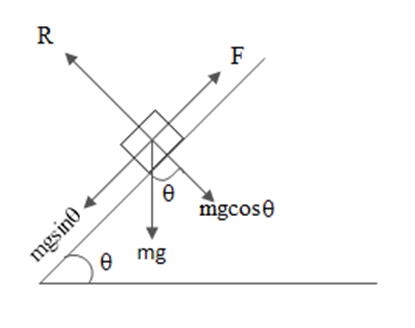
To keep the body in motion, the Force must be equal to the sum of friction and horizontal component of Normal reaction. i.e.
Least force (F) = frictional force + Horizontal component of normal reaction
Or, [latex]100 = \mu R + mg\sin\theta[/latex]
Or, [latex]100 = \mu mg\cos\theta + mg\sin\theta[/latex]
You've reached the end of the free preview. Continue with NN Premium.
- Complete access to every Premium chapter
- Notes, QBank, solutions & MCQs
- Premium PDFs & study resources
- Entrance preparation & mock tests
One NN Premium subscription unlocks everything.