
Vectors
SYLLABUS
Triangle, parallelogram and polygon laws of vectors, Resolution of vectors; Unit vectors, Scalar and vector products.
What is This Chapter About?
Physics deals with two kinds of quantities: those that are completely described by a number and a unit, and those that also require a direction. A temperature of 37°C, a mass of 5 kg, a time of 10 seconds — these are scalar quantities. But a force of 20 N pushing northward, a velocity of 60 km/h toward the east, a displacement of 5 m upward — these are vector quantities, and direction is an inseparable part of their meaning.
Chapter 2 of NEB Grade 11 Physics introduces students to the mathematics of vectors — how to represent them, add and subtract them, resolve them into components, and use them to solve real physical problems. Mastery of vectors is not optional in physics; it is essential. Every chapter that follows — from kinematics and dynamics to electrostatics and magnetism — relies on the ideas developed here.
Key Concepts You Will Learn
Scalars and Vectors
The first step is learning to distinguish between scalar and vector quantities. Scalars like mass, speed, temperature, and energy are fully described by magnitude alone. Vectors like displacement, velocity, acceleration, force, and momentum require both magnitude and direction. A common mistake is confusing speed (scalar) with velocity (vector) — this chapter clarifies that distinction once and for all.
Graphical Methods of Vector Addition
Vectors cannot be added the way ordinary numbers are. Instead, they follow geometric rules. This chapter covers three graphical methods of vector addition — the triangle law, the parallelogram law, and the polygon law. In the triangle law, two vectors are placed head to tail and the resultant is drawn from the tail of the first to the head of the second. The parallelogram law places both vectors at the same point and the resultant is the diagonal of the parallelogram they form. The polygon law extends this to more than two vectors.
Unit Vectors and Resolution of Vectors
A unit vector is a vector with magnitude exactly equal to 1, used purely to indicate direction. The standard unit vectors [latex]\hat{i}[/latex], [latex]\hat{j}[/latex], and [latex]\hat{k}[/latex] point along the x, y, and z axes respectively. Any vector can be written as a combination of these unit vectors.
Resolution is the reverse of addition — breaking a single vector into two perpendicular components. A vector [latex]\vec{A}[/latex] at angle [latex]\theta[/latex] to the horizontal has a horizontal component [latex]A\cos\theta[/latex] and a vertical component [latex]A\sin\theta[/latex]. This technique is the foundation of solving all force and motion problems involving angles.
Scalar and Vector Products
Two vectors can be multiplied in two fundamentally different ways. The scalar product (dot product) gives a scalar result: [latex]\vec{A} \cdot \vec{B} = AB\cos\theta[/latex]. It is used to calculate work done by a force. The vector product (cross product) gives a vector result: [latex]|\vec{A} \times \vec{B}| = AB\sin\theta[/latex], directed perpendicular to both original vectors. It is used to calculate torque and magnetic force.
Understanding when to use which product — and why — is a key conceptual skill this chapter develops.
Why This Chapter Matters for NEB Exams
Vectors carry 4 teaching hours and appear in NEB exams both as direct questions and as tools needed to solve problems in other chapters. Common exam questions include finding the resultant of two or more vectors using the component method, proving vector identities, and calculating dot and cross products. The component method of vector addition is used in almost every Dynamics and Kinematics problem.
Important Topics to Focus On
- Distinguishing scalars and vectors with examples
- Triangle, parallelogram, and polygon laws of vector addition
- Resolving vectors into perpendicular components
- Unit vectors [latex]\hat{i}[/latex], [latex]\hat{j}[/latex], [latex]\hat{k}[/latex] and their properties
- Scalar product: definition, formula, and application to work
- Vector product: definition, formula, direction using right-hand rule, and application to torque
- Numerical problems using the component method
Connection to Other Chapters
Vectors are the language of physics. Chapter 3 (Kinematics) uses vector resolution to analyse projectile motion. Chapter 4 (Dynamics) uses vector addition to find net force. Chapter 6 (Circular Motion) uses cross products for angular quantities. Electrostatics and magnetism in later chapters are almost entirely vector-based. Time invested in truly understanding Chapter 2 pays dividends throughout the entire two-year course.
Scalers:
Those physical quantities which have magnitude but no direction is called scalars. They follow ordinary algebraic rules for the operation of scalars. Eg. speed, mass, length, time, work done, etc.
Vectors:
Those physical quantities which have both magnitude and direction and follow the rules of vector rules of operation. For Eg. velocity, displacement, force, linear momentum, acceleration, etc.
Vectors are represented by the straight lines with arrow heads. Length of the line gives the magnitude of that vector and arrow heads gives the direction.
Laws of addition of vector:
1) Head tail combination:
a) [latex]\vec{P} + \vec{Q}[/latex]
b) [latex]\vec{Q} + \vec{P}[/latex]

Triangle law of vector addition:

It states that if two vectors acting at a point simultaneously be represented in magnitude and direction by two sides of a triangle taken in the same order then third side of the triangle in the reverse order represents magnitude and direction of the resultant vector of these two vectors.
Suppose two vector P and Q acting on a point simultaneously making an angle [latex]\theta[/latex] shown in figure (a). These two vectors are represented in magnitude and direction by two sides [latex]\vec{AB}[/latex] and [latex]\vec{B}[/latex] of a triangle [latex]\Delta[/latex]ABC in the same order then third side of the triangle in a reversed order i.e. [latex]\vec{AC}[/latex] represents magnitude and direction of the resultant vectors as shown in the figure (b).
In [latex]\Delta[/latex]ABC,
[latex]\vec{AC}=\vec{AB}+\vec{BC}[/latex]
[latex]\vec{R}=\vec{P}+\vec{Q}[/latex]………………….. (i)
Draw CD ⊥ AB produced.
In [latex]\Delta[/latex]BDC,
Cos[latex]\theta = \frac{BD}{BC}[/latex]
Or, BD = QCos[latex]\theta[/latex]
Sin[latex]\theta = \frac{CD}{BC}[/latex]
Or, CD = QSin[latex]\theta[/latex]
Then,
AD = AB + BD
= P + QCos[latex]\theta[/latex]
Now, using Pythagoras theorem in [latex]\Delta[/latex]ADC, we get,
AC2 = AD2 + CD2
R2 = (P + QCos[latex]\theta[/latex])2 + (QSin[latex]\theta[/latex])2
R2 = P2 + 2PQCos[latex]\theta[/latex] + Q2Cos2[latex]\theta[/latex] + Q2Sin2[latex]\theta[/latex]
R2 = P2 + 2PQCos[latex]\theta[/latex] + Q2(Cos2[latex]\theta[/latex] + Sin2[latex]\theta[/latex])
R2 = P2 + 2PQCos[latex]\theta[/latex] + Q2
R = [latex]\sqrt{P^2+Q^2+2PQCos\theta}[/latex] ………………… (ii)
Let, β be the angle made by [latex]\vec{R}[/latex] with [latex]\vec{P}[/latex], then,
Tanβ = [latex]\frac{CD}{AD}[/latex]
Or, Tanβ = [latex]\frac{QSin\theta}{P+QCos\theta}[/latex] ………………. (iii)
Specific cases:
Case I:
If [latex]\theta[/latex] = 0o, then,
R = [latex]\sqrt{P^2+Q^2+2PQCos0^o}[/latex]
Or, R = [latex]\sqrt{P^2+Q^2+2PQ}[/latex]
Or, R = P + Q
∴ Tanβ = [latex]\frac{QSin0^o}{P+QCos0^o}[/latex] = 0
∴ β = 0o
Case II:
If [latex]\theta[/latex] = 90o, then,
R = [latex]\sqrt{P^2+Q^2+2PQCos90^o}[/latex]
Or, R = [latex]\sqrt{P^2+Q^2}[/latex]
∴ Tanβ = [latex]\frac{QSin90^o}{P+QCos90^o} = \frac{Q}{P}[/latex]
∴ β = Tan-1 [latex](\frac{Q}{P})[/latex]
Case III:
If [latex]\theta[/latex] = 180o, then,
R = [latex]\sqrt{P^2+Q^2+2PQCos180^o}[/latex]
= [latex]\sqrt{P^2+Q^2-2PQ}[/latex]
= P – Q if P > Q
= Q – P if Q > P
Tanβ = [latex]\frac{QSin180^o}{P+QCos180^o} = 0[/latex]
∴ β = 0o.
Parallelogram law of vector addition:

It states that, if two vectors acting at a point simultaneously be represented in magnitude and direction by two adjacent sides of a parallelogram then the diagonal of it passing through the point of intersection of these adjacent sides represents magnitude and direction of the resultant vector of these two vectors.
Suppose, two vectors [latex]\vec{A}[/latex] and [latex]\vec{B}[/latex] are acting at a point O simultaneously making an angle [latex]\theta[/latex] as shown in fig. (a). These two vectors [latex]\vec{A}[/latex] and [latex]\vec{B}[/latex] are represented in magnitude and direction by two adjacent sides [latex]\vec{OP}[/latex] and [latex]\vec{OS}[/latex]. On parallelogram OPQS, then, the diagonal [latex]\vec{OQ}[/latex] represents the magnitude and direction of the resultant vector [latex]\vec{R}[/latex].
So, [latex]\vec{OQ}=\vec{OP}+\vec{PQ}[/latex]
[latex]\vec{R}=\vec{A}+\vec{B}[/latex]…….…………… (A)
Now, drop a perpendicular from Q on OM so they meet at M.
From right angled triangle [latex]\Delta[/latex]OQM,
OQ2 = OM2 + QM2
Or, R2 = (OP + PM)2 + QM2
Or, R2 = OP2 + 2.OP.PM + PM2 + QM2 ……………. (i)
In right angled [latex]\Delta[/latex]PQM,
Sin[latex]\theta = \frac{QM}{PQ} = \frac{QM}{B}[/latex]
Or, QM = BSin[latex]\theta[/latex]
And, Cos[latex]\theta = \frac{PM}{PQ} = \frac{PM}{B}[/latex]
Or, PM = BCos[latex]\theta[/latex]
Then, by substituting the values of OP, QM and PM, we get,
R2 = A2 + 2ABCos[latex]\theta[/latex] + B2Cos2[latex]\theta[/latex] + B2Sin2[latex]\theta[/latex]
Or, R2 = A2 + 2ABCos[latex]\theta[/latex] + B2 (Cos2[latex]\theta[/latex] + Sin2[latex]\theta[/latex])
Or, R2 = A2 + 2ABCos[latex]\theta[/latex] + B2 [Since, Sin2[latex]\theta[/latex] + Cos2[latex]\theta[/latex] = 1]
Or, R = [latex]\sqrt{A^2+2ABCos\theta + B^2}[/latex]
∴ R = [latex]\sqrt{A^2+B^2+2ABCos\theta}[/latex]
Which is the magnitude of resultant of [latex]\vec{A}[/latex] and [latex]\vec{B}[/latex].
Now, for direction of resultant [latex]\vec{R}[/latex], let us suppose, ‘β’ is the angle made by resultant with the direction of [latex]\vec{A}[/latex]
In [latex]\Delta[/latex]OQM,
tanβ = [latex]\frac{QM}{OM} = \frac{BSin\theta}{OM} = \frac{BSin\theta}{A+BCos\theta}[/latex]
Or, β = tan-1 [latex](\frac{BSin\theta}{A+BCos\theta})[/latex]
This gives the direction of resultant vector.
Special Cases:
1) When two vectors are acting in the same direction, then [latex]\theta[/latex] = 0o.
∴ R = [latex]\sqrt{A^2+B^2+2ABCos0^o}[/latex]
= [latex]\sqrt{A^2+B^2+2AB}[/latex] [Since, Cos0o = 1]
Or, R = [latex]\sqrt{(A+B)^2}[/latex]
Or, R = (A + B)
i.e., resultant is algebraic sum of magnitude of two vectors.
And, β = tan-1 [latex](\frac{BSin0^o}{A+BCos0^o})[/latex]
= tan-1 ([latex]\frac{B\times 0}{A+B\times 1}[/latex])
Or, β = tan-1(0) = 0
i.e., the resultant coincides with given two vectors.
2) When two vectors are acting at right angles, then [latex]\theta[/latex] = 90o.
∴ R = [latex]\sqrt{A^2+B^2+2ABCos90^o}[/latex]
= [latex]\sqrt{A^2+B^2+0}[/latex] [Since, Cos90o = 0]
Or, R = [latex]\sqrt{A^2+B^2}[/latex]
And, β = tan-1 [latex](\frac{B}{A})[/latex]
3) When two vectors are acting in the opposite direction, then, [latex]\theta[/latex] = 180o.
∴ R = [latex]\sqrt{A^2+B^2+2ABCos180^o}[/latex]
= [latex]\sqrt{A^2+B^2-2AB}[/latex] [Since, Cos180o = -1]
Or, R = [latex]\sqrt{(A-B)^2}[/latex]
Or, R = A – B
i.e., Resultant is the difference of magnitude of two vectors.
And, β = tan-1 [latex](\frac{BSin180^o}{A+BCos180^o})[/latex]
Or, β = tan-1(0) = 0
i.e., resultant is directed towards the bigger one.
Polygonal law of vector addition:
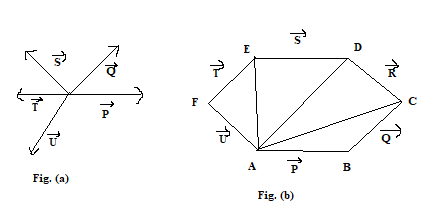
It states that, if many vectors acting at a point simultaneously be represented in magnitude and direction by sides of a polygon taken in same order then, the last side of it taken in the reverse order gives magnitude and direction of the resultant vector of these vectors.
Suppose, a number of vectors P, Q, R, S, T and U are acting at a point simultaneously as shown in figure (a). These vectors are represented in magnitude and direction by sides [latex]\vec{AB}[/latex], [latex]\vec{BC}[/latex], [latex]\vec{CD}[/latex], [latex]\vec{DE}[/latex], [latex]\vec{EF}[/latex] and [latex]\vec{FA}[/latex]. A polygon ABCDEF in the same order, the last side of a polygon [latex]\vec{FA}[/latex] i.e. [latex]\vec{AF}[/latex] in the reverse order gives magnitude and direction of the resultant vector.
Join AC, AD and AE.
In [latex]\Delta[/latex]ABC,
[latex]\vec{AC}[/latex] = [latex]\vec{AB}[/latex] + [latex]\vec{BC}[/latex]
= [latex]\vec{P}+\vec{Q}[/latex]
In [latex]\vec{\Delta}[/latex]ACD,
[latex]\vec{AD}[/latex] = [latex]\vec{AC}[/latex] + [latex]\vec{CD} = \vec{P}+\vec{Q}+\vec{S}[/latex]
In [latex]\Delta[/latex]ADE,
[latex]\vec{AE}=\vec{AD}+\vec{DE}[/latex]
= [latex]\vec{P}+\vec{Q}+\vec{S}+\vec{T}[/latex]
In [latex]\Delta[/latex]ADE,
[latex]\vec{AF}=\vec{AE}+\vec{EF}[/latex]
[latex]\vec{R}=\vec{P}+\vec{Q}+\vec{S}+\vec{T}+\vec{U}[/latex]
Resolution of a vector: rectangular components:
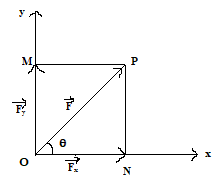
The process of splitting of a vector into its parts is known as resolution and split parts are called component. If they are perpendicular to each other then they are called rectangular components.
Let, q be the angle made by [latex]\vec{OP}[/latex] = [latex]\vec{F}[/latex] with x – axis. Draw PN perpendicular to x – axis and PM ⊥ y axis.
Then, ON = Fx and OM = Fy are rectangular components of [latex]\vec{F}[/latex].
In [latex]\Delta[/latex]ONP,
Cos[latex]\theta = \frac{ON}{OP}[/latex]
Or, ON = OPCos[latex]\theta[/latex]
Or, Fx = FCos[latex]\theta[/latex] ……………. (i)
Again,
Sin[latex]\theta[/latex] = [latex]\frac{PN}{OP}[/latex]
Or, PN = OPSin[latex]\theta[/latex]
Or, OM = PN = OPSin[latex]\theta[/latex]
Or, Fy = FSin[latex]\theta[/latex] ………………. (ii)
Squatting and adding eqn. (i) and (ii), we get,
Fx2 + Fy2 = F2Sin2[latex]\theta[/latex] + F2Cos2[latex]\theta[/latex]
= F2 x 1
Fx2 + Fy2= F
Or, F = [latex]\sqrt{F_x^2+F_y^2}[/latex]
Dividing eqn. (ii) by (i), we get,
[latex]\frac{F_y}{F_x} = Tan\theta[/latex]
Or, Tan[latex]\theta = \frac{F_y}{F_x}[/latex]
Dot or Scalar Product:
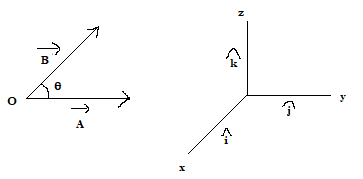
Let, [latex]\theta[/latex] be the angle between two vectors [latex]\vec{A}[/latex] and [latex]\vec{B}[/latex]. The dot or scalar product of these two vectors is defined as:
[latex]\vec{A}.\vec{B} = |\vec{A}|.|\vec{B}|Cos\theta[/latex]
= ABCos[latex]\theta[/latex] ………………. (i)
Where, [latex]\vec{i}, \vec{j}[/latex] and [latex]\vec{k}[/latex] are unit vectors along x – axis, y – axis and z – axis respectively.
[latex]\hat{i}.\hat{i}=|\hat{i}||\hat{i}|Cos0^o[/latex]
= 1 x 1 x 1 = 1
∴ [latex]\hat{i}.\hat{i} = \hat{j}.\hat{j}=\hat{k}.\hat{k} = 1[/latex]
∴ [latex]\hat{i}.\hat{j}=|\hat{i}||\hat{j}|Cos90^o[/latex]
= 1 x 1 x 0 = 0
∴ [latex]\hat{i}.\hat{j}=\hat{j}.\hat{k}=\hat{k}.\hat{i}[/latex] = 0
If [latex]\vec{A}[/latex] = Ax [latex]\hat{i}[/latex] + Ay [latex]\hat{j}[/latex] and
[latex]\vec{B}[/latex] = Bx [latex]\hat{i}[/latex] + By [latex]\hat{j}[/latex], then,
[latex]\vec{A}.\vec{B} = (A_x\hat{i}+A_y\hat{j}+A_z\hat{k}).(B_x\hat{i}+B_y\hat{j}+B_z\hat{k})[/latex]
= AxBx + AyBy + AzBz ………………….. (ii)
Which is required expression for dot or scalar product.
MCQs
Which of the following is scalar quantity?
Show answer
Electric current is
Show answer
Which of the following is odd one?
Show answer
If angle between two equal forces (F) is [latex]90^o[/latex], then the magnitude of the resultant is
Show answer
If two vectors each having magnitude ‘P’ is acting at a point and angle between them is [latex]\theta[/latex], then the resultant is given by
Show answer
If magnitude of resultant of two forces F and F acting at a point is also F, the angle between the forces is
Show answer
Small elementary area is a
Show answer
The vector [latex]\vec{S}[/latex] is defined as [latex]\vec{S} = \vec{a} – \vec{b}[/latex], then the magnitude of [latex]\vec{S}[/latex] is
Show answer
A man is running due north at 2m/s turns east and runs at the same speed. What is the change in velocity?
Show answer
If [latex]\vec{a}[/latex] and [latex]\vec{b}[/latex] have same magnitude ‘p’ and angle between [latex]\vec{a}[/latex] and [latex]\vec{b}[/latex] is [latex]\theta[/latex], the magnitude of vector [latex]\vec{a} – \vec{b}[/latex] is
Show answer
An airplane is moving on a circular path with the speed 200 km/hr. What is the change in velocity in half revolution?
Show answer
If force [latex]\vec{F} = \vec{i} + \vec{j} + \vec{k}[/latex] and displacement [latex]\vec{d} = 3\vec{i} + 2\vec{j} + 5\vec{k}[/latex] are perpendicular to each other, then, work done by force is
Show answer
If [latex]|\vec{A}.\vec{B}| = |\vec{A} \times \vec{B}|[/latex], then resultant of [latex]\vec{A}[/latex] and [latex]\vec{B}[/latex] is
Show answer
What can be the angle between [latex]\vec{A} + \vec{B}[/latex] and [latex]\vec{A} – \vec{B}[/latex]?
Show answer
The maximum and minimum magnitudes of the resultant of two vectors of magnitudes [latex]\vec{A}[/latex] and [latex]\vec{B}[/latex] are in the ratio 3:1. Which of the following relations is true?
Show answer
Theoretical questions
If [latex]\vec{A} = 4\hat{i}-\hat{j}+3\hat{k}[/latex] and [latex]\vec{B}=7\hat{i}+5\hat{j}+\hat{k}[/latex], find the angle between the vectors [latex]\vec{A}[/latex] and [latex]\vec{B}[/latex]. Ans: 0o
[latex]\vec{A}[/latex] and [latex]\vec{B}[/latex] are two non – zero vectors. If |[latex]\vec{A}\times \vec{B}[/latex]| = [latex]\vec{A}.\vec{B}[/latex], what it the angle between [latex]\vec{A}[/latex] and [latex]\vec{B}[/latex]? Ans: 45o
If [latex]\vec{A}.\vec{B}=0[/latex], what is angle between [latex]\vec{A}[/latex] and [latex]\vec{B}[/latex]? Ans: 90o
Resultant of two equal forces may have the magnitude equal to one of the forces. At what angle between the two equal forces this is possible? Justify your answer. Ans: 120o
OR
Two vectors have equal magnitudes and their resultant also has the same magnitude. What is the angle between the two vectors?
Two vectors are given as [latex]\vec{V_1} = 2\hat{i}+3\hat{j}+4\hat{k}[/latex] and [latex]\vec{V_2} = 3\hat{i}+2\hat{j}-4\hat{k}[/latex]. Which one of the two is larger in magnitude? Justify your answer. Ans: Equal
A vector is defined as [latex]\vec{E} = 2\hat{i}+3\hat{j}-4\hat{k}[/latex]. What is the magnitude of Y-component of [latex]\vec{E}[/latex]? Ans: 3
Can the sum of two equal vectors be equal to either vector? Ans: Yes, [latex]\theta = 120^o[/latex]
Given two vectors [latex]\vec{A} = 4.00\hat{i}+3.00\hat{j}[/latex] and [latex]\vec{B}=5.00\hat{i}-2.00\hat{j}[/latex]. Find the magnitude of each vector. Ans: A = 5.00, [latex]B=\sqrt{29}[/latex]
A vector [latex]\vec{F}=\hat{i}+2\hat{j}-3\hat{k}[/latex] is given. What is the magnitude of the y-component of the vector? Ans: 2
Is a physical quantity having magnitude and direction necessarily a vector quantity? Explain.
A force (in Newton) expressed in vector notation as [latex]\vec{F}=2\hat{i}+\hat{j}-3\hat{k}[/latex] is applied on a body so that the displacement produced in meter is given by [latex]\vec{D}=\hat{i}-2\hat{j}-3\hat{k}[/latex]. Express the result and nature of the work done. Ans: 9 J
A force (in Newton) expressed in vector notation as [latex]\vec{F}=4\hat{i}+7\hat{j}-3\hat{k}[/latex] is applied on a body and produces a displacement (in meter), [latex]\vec{D}=3\hat{i}-2\hat{j}-5\hat{k}[/latex] in 4 seconds. Estimate the power. Ans: 3.25 watt
What does [latex]\vec{A}.\vec{A}[/latex], the scalar product of a vector with itself give? What about [latex]\vec{A}\times \vec{A}[/latex] the vector product of a vector with itself?
Can you find a vector quantity that has a magnitude of zero but components that are different from zero? Explain.
If [latex]\hat{i}, \hat{j}[/latex] and [latex]\vec{k}[/latex] are unit vectors along x, y and z – axis respectively, find [latex]\hat{i}.(\hat{k}\times \hat{j})[/latex]. Ans: – 1
The angle between two vectors [latex]\vec{A}[/latex] and [latex]\vec{B}[/latex] is θ. Find the magnitude and direction of [latex]\vec{A}\times \vec{B}[/latex] and [latex]\vec{A}.\vec{B}.[/latex]
[latex]\hat{i},\hat{j}[/latex] and [latex]\hat{k}[/latex] are unit vectors of a force along X, Y and Z axes respectively. Find the magnitude and direction of the vector product of two forces [latex]\vec{F_1}[/latex] and [latex]\vec{F_2}[/latex] if [latex]\vec{F_1}=3\hat{i}[/latex] and [latex]\vec{F_2} = -2\hat{k}.[/latex] Ans: [latex]6\hat{j}[/latex]
If [latex]\vec{A}[/latex] and [latex]\vec{B}[/latex] are non zero vectors, is it possible for [latex]\vec{A}\times \vec{B}[/latex] and [latex]\vec{A}.\vec{B}[/latex] both to be zero? Explain. Ans: Impossible
If a vector has zero magnitude, is it meaningful to call it vector? Ans: Yes
If the scalar product of two vectors is equal to the magnitude of their vector product, find the angle between them. Ans: [latex]45^o[/latex]
[latex]\vec{C}[/latex] is the vector sum of [latex]\vec{A}[/latex] and [latex]\vec{B}[/latex] i.e. [latex]\vec{C} = \vec{A} + \vec{B}[/latex] for C = A + B to be true, what is the angle between [latex]\vec{A}[/latex] and [latex]\vec{B}[/latex]? Ans: [latex]0^o[/latex]
The magnitude of two vectors are 3 and 4, and their product is 6. What is the angle between them? Ans: [latex]60^o[/latex]
Two vectors [latex]\vec{A}[/latex] and [latex]\vec{B}[/latex] are such that [latex]\vec{A}-\vec{B} = \vec{C}[/latex] and A – B = C. Find the angle between them. Ans: [latex]0^o[/latex]
What is the difference between scalar and vector products of two vectors? Explain.
If the scalar product of two vectors is equal to the magnitude of their vector product, find the angle between them. Ans: [latex]45^o[/latex]
If [latex]\vec{B}[/latex] is added [latex]\vec{A}[/latex], under what condition does the vector have a magnitude equal to A + B? Under what conditions is the resultant vector equal to zero?
Is momentum of a moving body a vector or a scalar?
Long Answer Questions
State and explain the parallelogram law of vector addition, derive the magnitude and direction of the resultant vector.
State triangle law of vector addition. Obtain an expression for the resultant of two vectors P and Q inclined at angle [latex]\theta[/latex].
Numerical problems
A disoriented physics professor drives 3.25 km north, then 4.75 km west and then 1.50 km south. Find the magnitude and direction of the resultant displacement. Ans: 5.06 Km, 159.8o
A rocket fires two engines simultaneously. One produces a thrust of 725 N directly forward, while the other gives a 513 N thrust at 32.4o above the forward direction. Find the magnitude and direction of the resultant force that these engines exert on the rocket. Ans: 1190 N, 13.4o with [latex]\vec{F_1}[/latex]
- [latex]\vec{A}[/latex] and [latex]\vec{B}[/latex] are two non-zero vectors. If |[latex]\vec{A}\times \vec{B}[/latex]| = [latex]\vec{A}.\vec{B}[/latex], what is the angle between [latex]\vec{A}[/latex] and [latex]\vec{B}[/latex] ?
OR, If the scalar product of two vectors in equal magnitude of their product, find the angle between them.
Solution:
Let [latex]\theta[/latex] be the angle between [latex]\vec{A}[/latex] and [latex]\vec{B}[/latex]. The scalar product of [latex]\vec{A}[/latex] and [latex]\vec{B}[/latex] is given by[latex]\vec{A}.\vec{B}=ABCos\theta[/latex] ……………………… (i)
The magnitude of the vector product of and is given by,
|[latex]\vec{A}\times \vec{B}[/latex]| = ABsin[latex]\theta[/latex] ……………….. (ii)
According to the question, we have,
[latex]\vec{A}.\vec{B}=|\vec{A}\times \vec{B}|[/latex]Or, ABcos[latex]\theta = ABSin\theta[/latex]
Or, [latex]tan\theta = 1[/latex]
[latex]∴ \theta = 45^o[/latex]
Hence, required angle is 45o.
- If [latex]\vec{A}.\vec{B}=0,[/latex] what is the value of angle between [latex]\vec{A}[/latex] and [latex]\vec{B}[/latex]?
Solution:
[latex]\vec{A}.\vec{B}=|\vec{A}||\vec{B}|Cos\theta = AB Cos\theta[/latex], where [latex]\theta[/latex] be the angle between [latex]\vec{A}[/latex] and [latex]\vec{B}[/latex].When two vectors [latex]\vec{A}[/latex] & [latex]\vec{B}[/latex] are perpendicular to each other, i.e.
When [latex]\theta = 90^o[/latex], then, [latex]\vec{B}=AB Cos90^o[/latex] = 0
Hence, for [latex]\vec{A}.\vec{B}=0[/latex], the angle between [latex]\vec{A}[/latex] and [latex]\vec{B}[/latex] must be 90o.
- Resultant of two equal forces may have the magnitude equal to one of the forces. At what angle between the two equal forces this is possible? Justify your answer.
OR, Two vectors have equal magnitudes and their resultant also has the same magnitude. What is the angle between the two vectors?
Ans: [latex]\theta[/latex] Let be the angle between two equal vectors, each vector [latex]\vec{A}[/latex], so that resultant (sum) vector [latex]\vec{R}[/latex] has also magnitude A.
We have, R2 = A2 + B2 + 2ABcos[latex]\theta[/latex]
∴ [latex]A^2=A^2+A^2+2AACos\theta[/latex] [∵ R = a and A = B]
Or, A2 = 2A2 + 2A2cos[latex]\theta[/latex]
Or, 1 = 2 + 2cos[latex]\theta[/latex]
Or, 2cos[latex]\theta = -1[/latex]
Or, cos[latex]\theta = -\frac{1}{2}[/latex]
∴ [latex]\theta = 120^o[/latex]
Hence, required angle is 120o.
- Two vectors are given as [latex]\vec{V_1} = 2\hat{i}+3\vec{j}+4\vec{k}[/latex] and [latex]\vec{V_2}=3\hat{i}-2\hat{j}-4\hat{k}[/latex]. Which one of the two is larger in magnitude? Justify your answer.
Ans: [latex]\vec{V_1}=2\hat{i}+3\hat{j}+4\hat{k}[/latex]
[latex]\vec{V_2}=3\hat{i}-2\hat{j}-4\hat{k}[/latex]
Magnitude of V1 = [latex]\sqrt{2^2+3^2+4^2 = \sqrt{29}}[/latex]
Magnitude of V2 = [latex]\sqrt{3^2+(-2)^2+(-4)^2} = \sqrt{29}[/latex]
Both vectors have same magnitude and are equal.
- A vector is defined as [latex]\vec{E}=2\hat{i}+3\hat{j}-4\hat{k}[/latex]. What is the magnitude of y-component of [latex]\vec{E}[/latex]?
Ans: Every vector [latex]\hat{A}[/latex] can be represented in three rectangular components of the vector as
[latex]\vec{A}=\vec{A_x}+\vec{A_y}+\vec{A_z}[/latex]
Or, [latex]\vec{A}=A_x\hat{i}+A_y\hat{j}+A_z\hat{k}[/latex]
Here, the given vector is [latex]\vec{E}=2\hat{i}+3\hat{j}-4\hat{k}[/latex]
Hence, x-component = 2
y-component = 3
z-component = – 4
- Given two vectors [latex]\vec{A}=4.00\hat{i}+3.00\hat{j}[/latex] and [latex]\vec{B}=5.00\hat{i}-2.00\hat{j}[/latex]. Find the magnitude of each vector.
Ans: Here given
[latex]\vec{A}=4.00\hat{i}+3.00\hat{j}[/latex]
[latex]\vec{B}=5.00\hat{i}-2.00\hat{j}[/latex]
Magnitude of each vector =?
Here, Ax = 4.00 and Ay = 3.00
Bx = 5.00 and By = – 2.00
Now, magnitude of [latex]\vec{A}, |\vec{A}|=\sqrt{A_x^2+A_y^2}=\sqrt{4.00^2+3.00^2}=5.00[/latex]
Magnitude of [latex]\vec{B}, |\vec{B}|=\sqrt{B_x^2+B_y^2}=\sqrt{5.00^2+(-2.00)^2}=5.39[/latex]
- A vector [latex]\vec{F}=\hat{i}+2\hat{j}-3\hat{k}[/latex] is given. What is the magnitude of the y-component of the vector?
Ans: Every vector [latex]\vec{A}[/latex] can be represented in three rectangular components of the vector as
[latex]\vec{A}=\vec{A_x}+\vec{A_y}+\vec{A_z}[/latex]
Or, [latex]\vec{A} = A_x\hat{i}+A_y\hat{j}+A_z\hat{k}[/latex]
Here, given vector [latex]\vec{F} = \hat{i}+2\hat{j}-3\hat{k}[/latex]
Hence, x – component = 1
y – component = 2
z – component = – 3
- Is a physical quantity having magnitude and direction necessarily a vector quantity? Explain.
Ans: No. A physical quantity having magnitude and direction shouldn’t be necessarily a vector. The quantity should have one additional property: it should obey the laws of vectors (for example, triangle law of vector addition, parallelogram law of vector addition). Consider the physical quantity pressure which has both magnitude and direction, still it isn’t a vector. This is because it doesn’t obey laws of vectors instead it behaves like a scalar quantity.
- A force (in Newton) expressed in vector notation as [latex]\vec{F}=2\hat{i}+\hat{j}-3\hat{k}[/latex] is applied on a body so that the displacement produced in meter is given by [latex]\vec{D}=\hat{i}-2\hat{j}-3\hat{k}[/latex]. Express the result and nature of the work done.
Ans: Here,
Now,
W = [latex]\vec{F}.\vec{D} = (2\hat{i}+\hat{j}-3\hat{k})(\hat{i}-2\hat{j}-3\hat{k})[/latex] = 2 – 2 + 9
= 9 J (positive work)
- A force (in Newton) expressed in vector notation as [latex]\vec{F}=4\hat{i}+7\hat{j}-3\hat{k}[/latex] is applied on a body and produces a displacement (in meter), [latex]\vec{D}=3\hat{i}-2\hat{j}-5\hat{k}[/latex] in 4 seconds. Estimate the power.
Ans: Here,
[latex]\vec{F}=4\hat{i}+7\hat{j}-3\hat{k}[/latex]
[latex]\vec{D}=3\hat{i}-2\hat{j}-5\hat{k}[/latex]
t = 4 seconds
Now,
W = [latex]\vec{F}.\vec{D} = (4\hat{i}+7\hat{j}-3\hat{k}).(3\hat{i}-2\hat{j}-5\hat{k})[/latex]
= 12 – 14 + 15
= 13 J
∴ [latex]P=\frac{W}{t}=\frac{13}{4}=3.25 Watt[/latex]
- What does [latex]\vec{A}.\vec{A}[/latex], the scalar product of a vector with itself give? What about [latex]\vec{A}\times \vec{A}[/latex] the vector product of a vector with itself?
Ans: The scalar product of a vector with itself gives the square of its magnitude.
i.e. [latex]\vec{A}.\vec{A}=|A||A|cos0^o[/latex] (∵[latex]\theta = 0^o[/latex])
Or, [latex]\vec{A}.\vec{A}=A^2[/latex]
But, the vector product of a vector with itself is zero.
i.e. [latex]\vec{A}\times \vec{A}=|A||A|sin0^o[/latex]
∴ [latex]\vec{A}\times \vec{A}=0[/latex]
- If [latex]\hat{i}, \hat{j}[/latex] and [latex]\hat{k}[/latex] are unit vectors along x, y and z – axis respectively, find [latex]\hat{i}.(\hat{k}\times \hat{j})[/latex].
Ans: Here,
[latex]\hat{i}, \hat{j}[/latex] and [latex]\hat{k}[/latex] are the unit vectors along x, y and z – axis respectively.
Then, [latex]\hat{i}.(\hat{k}\times \hat{j})[/latex]
= [latex]\hat{i}.-\hat{i}[/latex] [∵ [latex]\hat{k}\times \hat{j}=-\hat{i}[/latex]]
= – 1 [∵ [latex]\hat{i}.\hat{i} = 1][/latex]
- The angle between two vectors [latex]\vec{A}[/latex] and [latex]\vec{B}[/latex] is [latex]\theta[/latex]. Find the magnitude and direction of [latex]\vec{A}\times \vec{B}[/latex] and [latex]\vec{A}.\vec{B}[/latex].
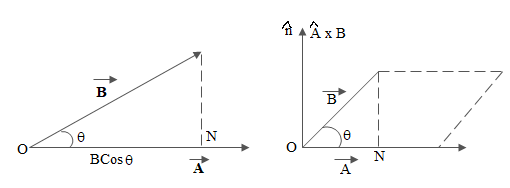
Ans: The scalar product of two vectors [latex]\vec{A}[/latex] and [latex]\vec{B}[/latex] is the product of the magnitude of one of the vectors and the projection of the second vector on the first.
∴ [latex]\vec{A}.\vec{B}=ABcos\theta[/latex]
The vector product of two vectors [latex]\vec{A}[/latex] and [latex]\vec{B}[/latex] is a vector which is perpendicular to the plane of the vectors [latex]\vec{A}[/latex] and [latex]\vec{B}[/latex] and whose magnitude is ABSin[latex]\theta[/latex]. Where A and B are the magnitude of [latex]\vec{A}[/latex] and [latex]\vec{B}[/latex] and [latex]\theta[/latex] is the angle between [latex]\vec{A}[/latex] and [latex]\vec{B}[/latex].
Symbolically,
[latex]\vec{A}\times \vec{B}=ABsin\theta \hat{n}[/latex]
Where,[latex]\hat{n}[/latex] is the unit vector normal to both [latex]\vec{A}[/latex] and [latex]\vec{B}[/latex].
- [latex]\hat{i}, \hat{j}[/latex] and [latex]\hat{k}[/latex] are the unit vectors of a force along X, Y and Z axes respectively. Find the magnitude and direction of the vector product of two forces [latex]\vec{F_1}[/latex] and [latex]\vec{F_2}[/latex]. If [latex]\vec{F_1} = 3\hat{i}[/latex] and [latex]\vec{F_2} = – 2\hat{k}[/latex].
Solution:
Here, [latex]\vec{F_1} = 3\hat{i}[/latex] and [latex]\vec{F_2} = – 2\hat{k}[/latex][latex]\therefore \vec{F_1} \times \vec{F_2} = 3\hat{i} \times (- 2\hat{k}) = 6\hat{j}[/latex]
The plane of [latex]\vec{F_1}[/latex] and [latex]\vec{F_2}[/latex] (the [latex]\hat{i} – \hat{k}[/latex] plane) is perpendicular to the direction of [latex]\vec{F_1} \times \vec{F_2}[/latex] (the [latex]\hat{j}[/latex] direction).
- If [latex]\vec{A}[/latex] and [latex]\vec{B}[/latex] are non zero vectors, is it possible for [latex]\vec{A} \times \vec{B}[/latex] and [latex]\vec{A}.\vec{B}[/latex] both to be zero? Explain.
Ans:
We know,
[latex]\vec{A} \times \vec{B} = ABsin\theta \hat{n}[/latex]
Or, 0 = [latex]ABsin\theta \hat{n}[/latex]
i.e. either A = 0 or B = 0 or Sin[latex]\theta = 0[/latex] ………………….. (i)
Also, [latex]\vec{A}.\vec{B} = ABcos\theta[/latex]
Or, 0 = ABCos[latex]\theta[/latex]
i.e. either A = 0 or B = 0 or cos[latex]\theta[/latex] = 0 ……………………….. (ii)
If [latex]\vec{A}[/latex] and [latex]\vec{B}[/latex] are non zero vectors, from equations (i) & (ii), it follows that [latex]\sin\theta[/latex] and [latex]\cos\theta[/latex] both should be zero simultaneously, which is impossible. - [latex]\vec{C}[/latex] is the vector sum of [latex]\vec{A}[/latex] and [latex]\vec{B}[/latex] i.e. [latex]\vec{C} = \vec{A} + \vec{B}[/latex] for C = A + B to be true, what is the angle between [latex]\vec{A}[/latex] and [latex]\vec{B}[/latex]?
Ans: Let, [latex]\theta[/latex] be the angle between [latex]\vec{A}[/latex] and [latex]\vec{B}[/latex].
We know,
C2 = [latex]\vec{C}.\vec{C}[/latex]
= [latex](\vec{A} + \vec{B})(\vec{A} + \vec{B})[/latex]
= [latex]\vec{A}.\vec{A} + \vec{A}.\vec{B} + \vec{B}.\vec{A} + \vec{B}.\vec{B}[/latex]
= A2 + ABcos[latex]\theta + BAcos\theta + B^2[/latex]
Or, C2 = A2 + B2 + 2ABCos[latex]\theta[/latex] ………………… (i)
Again, we have,
C = A + B
Or, C2 = (A + B)2
Or, C2 = A2 + B2 + 2AB …………….. (ii)
Comparing equations (i) and (ii), we get,
cos[latex]\theta = 1[/latex]
Or, [latex]\theta = cos^{-1}(1) = 0^o[/latex]
[latex]\therefore[/latex] Angle between two vectors is 0o, i.e. they are acting in the same direction. - The magnitude of two vectors are 3 and 4, and their product is 6. What is the angle between them?
Ans: Let, a and b be the magnitude of two vectors [latex]\vec{a}[/latex] and [latex]\vec{b}[/latex] respectively. According to the question, we have a = 3, b = 4 and [latex]\vec{a}.\vec{b} = 6[/latex] (Note that the product of [latex]\vec{a}[/latex] and [latex]\vec{b}[/latex] can’t be vector product i.e. [latex]\vec{a}\times \vec{b}[/latex]. This is because [latex]\vec{a}\times \vec{b}[/latex] is a vector but in accordance to the question the product is a scalar i.e. 6).
[latex]\therefore abcos\theta[/latex] = 6, [latex]\theta[/latex] is the angle between [latex]\vec{a}[/latex] and [latex]\vec{b}[/latex].
Or, 3 x 4 cos[latex]\theta = 6[/latex]
Or, cos[latex]\theta = \frac{1}{2}[/latex]
[latex]\therefore \theta = 60^o[/latex]
Hence, the required angle is 60o. - What is the difference between scalar and vector product of two vectors? Explain.
Ans: Following are differences between scalar and vector products of two vectors.
| Scalar Product | Vector Product |
| Scalar product of two vectors [latex]\vec{A}[/latex] and [latex]\vec{B}[/latex], denoted by [latex]\vec{A}.\vec{B}[/latex] is given by [latex]\vec{A}.\vec{B} = ABcos\theta[/latex] | Vector product of two vectors [latex]\vec{A}[/latex] and [latex]\vec{A}[/latex], denoted by [latex]\vec{A}\times \vec{B}[/latex], is given by [latex]\vec{A}\times B = ABsin\theta \hat{n}[/latex] , where [latex]\hat{n}[/latex] is unit vector which is given by right hand screw rule. |
| It is also called dot product. | It is also called cross product. |
| It is a scalar quantity | It is a vector quantity. |
| Scalar product of two vectors follows the commutative law. [latex]\vec{A}.\vec{B} = \vec{B}.\vec{A}[/latex] | Vector product of two vectors doesn’t follow commutative law. [latex]\vec{A}\times \vec{B} \neq \vec{B}\times \vec{A}[/latex] |
| Scalar product of two equal vector is square of the magnitude of either vector. i.e. [latex]\vec{A}.\vec{A} = A^2[/latex] | Vector product of two equal vector is zero. i.e. [latex]\vec{A}\times \vec{A} = 0[/latex] |
| Scalar product of two perpendicular vectors is zero. | Magnitude of vector product of two perpendicular vectors is equal to the product of magnitude of each vector. |
| Scalar product of two vector is the product of magnitude of projection of either vector on another vector and magnitude of another vector. | Magnitude of the vector product of two vectors represents the area of the parallelogram bounded by these vectors. |
Test what you’ve learned in this chapter with a quick self-graded quiz.
Start MCQ Quiz